
To send invoices legally in 2026, choose an English-first tool (Stripe, Zoho Books, QuickBooks, Xero or a Bulgarian-ready app), set the right VAT rules (domestic, EU reverse charge, or OSS), keep sequential invoice numbers, and share everything with your Bulgarian accountant for timely filings.
Key Takeaways
How invoicing works in Bulgaria (simple rules you can follow)
Invoicing is straightforward once you set the basics. You need sequential invoice numbers, correct VAT treatment, buyer details, and clear notes (for example, “Reverse charge — Article 196”). You can check company status in the official Commercial Register, follow EU VAT frameworks via the European Commission, and your accountant will handle VAT and VIES through the National Revenue Agency.
| Area | What to Include | Why It Matters | Where It Shows on the Invoice |
|---|---|---|---|
| Identity | Your company name, UIC, address; buyer details | Identifies seller and buyer for audits | Header and “Bill to” section |
| Sequence | Unique, chronological invoice number | Prevents gaps and manipulations | Invoice top-right or top-left |
| VAT | Rates, amounts, and reason if 0%/reverse charged | Correct tax and reports (VAT/VIES) | Line level + note (“Reverse charge — Article 196”) |
| Currency | EUR with clear exchange if needed | Consistent accounting in 2026 | Totals section and footnote |
| Delivery | Date of supply and issuance | Determines VAT period | Header or footer |
Best tools to send invoices from your Bulgarian LTD or EOOD
Here’s a hands-on comparison you can act on today. Each name links to the official product page so you can review features and pricing.
| Tool | What It’s Best For | VAT & VIES Support | Payments | Multi-Currency | Accountant Access | Typical Monthly (from) |
|---|---|---|---|---|---|---|
| Stripe Invoicing | Fast online invoices, payment links, subscriptions | Reverse charge notes; exportable data | Cards, wallets, bank methods | Yes | Viewer exports/API | 0 € + processing |
| Zoho Books | All-in-one invoicing + bookkeeping | VAT codes; reports; VIES exports | Stripe/PayPal integrations | Yes | Role-based; accountant portal | 15 € |
| QuickBooks Online | Service businesses; simple inventory | Configurable VAT; reports | Integrations & apps | Yes | Multi-user | 20 € |
| Xero | Teams; unlimited users; app ecosystem | VAT logic; VIES via add-ons | Stripe/PayPal integrations | Yes | Unlimited users | 20 € |
| PayPal Invoicing | Simple invoices paid by PayPal | Manual VAT lines/notes | PayPal balance & cards | Yes | Export CSV/PDF | 0 € + processing |
| Nula.bg | Bulgarian-ready invoicing, VAT, payroll | Bulgarian VAT module; VIES | Bank connections (open banking) | Yes | Unlimited users | 10 € |
| eFirma.bg | Clean invoices; expense scans | Bulgarian formats; bilingual | Invoice only (no gateway) | Yes | Shared workspace | 10 € |
| Eurofaktura | SMEs needing stock & multi-warehouse | Localized VAT & VIES | Integrations | Yes | Multi-user | 35 € |
Need a broader toolkit beyond invoicing? Compare your end-to-end options in our overview of the best accounting software for Bulgarian companies (English UI, VAT, payroll, bank feeds, and more).
How to invoice with Stripe, Zoho, or your ledger (step by step)

Below are simple flows many founders use. Swap Stripe for your preferred tool, and keep VAT logic and numbering consistent.
| Scenario | Tool Setup | Steps to Issue | VAT Note | Who Approves | Time |
|---|---|---|---|---|---|
| Service to EU VAT-registered client (B2B) | Stripe Invoicing with custom fields | Create client & item → add buyer VAT → issue invoice | Reverse charge (Article 196) | Director or accountant | 10–20 min |
| Monthly SaaS subscriptions | Stripe Billing or Zoho Books subscriptions | Define plan → tax rules → auto-billing | OSS may apply for EU B2C | Director | 30–60 min initial |
| Domestic B2B/B2C sales | Zoho/QuickBooks/Xero + payment link | Set VAT rates → issue → collect payment | Local Bulgarian VAT | Accountant checks | 10–15 min |
| E-commerce with inventory | Eurofaktura or Xero + app | Sync orders → auto-invoice → reconcile | Per destination rules | Ops + accountant | 1–2 hrs setup |
VAT, VIES, and invoice logic (with examples)
Pick VAT logic by buyer location and status. Reverse charge is common for EU B2B services. For EU B2C digital services, OSS applies. For domestic sales, use local VAT. Your accountant files VIES for EU B2B.
| Sale Type | Buyer | VAT Treatment | Invoice Note | Report |
|---|---|---|---|---|
| EU B2B services | EU VAT-registered company | Reverse charge | “Reverse charge — Article 196 EU VAT Directive” | VIES + VAT return |
| EU B2C digital | Consumer in EU | OSS (by destination) | “VAT via OSS (destination rate)” | OSS + VAT return |
| Domestic sale | Bulgarian customer | Local VAT | “VAT charged per Bulgarian law” | VAT return |
| Export outside EU | Non-EU customer | 0% (conditions apply) | “Export — zero-rated per evidence” | VAT return |
Company types (EOOD, OOD, AD, EAD), branches, and invoicing impact
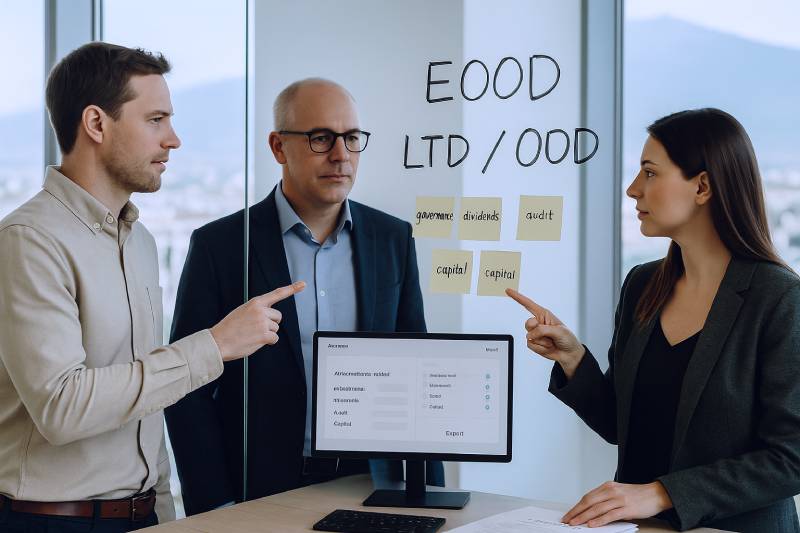
Your legal form shapes who signs, who can approve invoices, and which reports you need. Most remote founders start with an EOOD. If you add partners, switch to OOD. If you raise funds or need audits, consider EAD/AD. Branches invoice as part of the foreign parent; representative offices do not trade.
| Entity | Who It Fits | Approvals | Payroll Impact | Notes for Invoices |
|---|---|---|---|---|
| EOOD | Solo founders | Director approves | Optional (if salary) | Keep simple numbering; reverse charge for EU B2B |
| OOD | Two or more owners | Board rules & roles | Likely employees later | Define approval roles in software |
| EAD | Single shareholder JSC | Board structure | Standard payroll | Attach policies; fixed assets & audits |
| AD | Larger JSC | Supervisory + management | Team payroll | Consolidation and audit trails |
| Branch | Foreign company operating locally | As per parent | Local staff possible | Local VAT; records mirror parent |
| Representative Office | Research only, no sales | — | Headcount only | No invoices allowed |
If you plan to live outside Bulgaria most of the year, save time by learning how to manage your Bulgarian company from abroad with clear roles, signatures, and monthly routines.
Address, bank account, remote setup, and document flow
You need a registered seat and an address for service. Use a professional address if you live abroad. Open a Bulgarian business bank account and connect bank feeds. Store contracts, invoices, and receipts in a shared drive your accountant controls. For new registrations and online services, the starting point is the Bulgarian e-Government portal. Banking rules and infrastructure are supervised by the Bulgarian National Bank.
| Item | What to Prepare | Where to Store | Owner’s Action | Accountant’s Role |
|---|---|---|---|---|
| Registered seat | Seat contract; service address | Shared drive (invoices folder) | Sign and upload | Track notices; archive |
| Bank account | UBO IDs, articles, activity | Bank & ledger | Approve payments | Reconcile weekly |
| Invoicing app | Numbering, VAT codes, templates | App + exports | Issue & send | Review & file |
| E-signature | Qualified certificate | Password manager | Authorize filings | Prepare returns |
Realistic costs and timelines you can budget
Here is a simple overview. Numbers are rounded and typical for new founders in 2026.
| Item | DIY Cost | With Professional Help | When |
|---|---|---|---|
| Company formation (EOOD/OOD) | 300–600 € | 600–1,200 € | One-time |
| Registered seat (yearly) | 100–200 € | 100–200 € | Yearly |
| Business bank account | 0–200 € | 0–200 € | One-time |
| Invoicing/ledger software | 0–420 € | 0–420 € | Yearly |
| Monthly accounting | — | 60–250 € | Monthly |
| VAT registration support | — | 150–300 € | One-time |
| Step | Typical Duration | Dependency | What You Do | What Accountant Does |
|---|---|---|---|---|
| Company registration | 3–7 days | Docs signed | Sign and pay fees | File and confirm |
| Bank onboarding | 3–10 days | KYC cleared | Interview & documents | Set feeds & rules |
| VAT registration | 7–14 days | Activity proof | Provide invoices/contracts | Submit & follow up |
| Invoicing setup | 1–2 days | Bank feed live | Pick tool; templates | Check VAT logic |
Common pitfalls (and easy fixes)
- Wrong VAT notes. Add “Reverse charge — Article 196” for EU B2B services when applicable.
- Gaps in numbers. Keep continuous invoice sequences per series.
- No VIES export. Enable VIES reports and test before month end.
- Late reconciliation. Create bank rules and reconcile weekly.
- Mixing personal and business. Separate cards and post director expenses with proof.
When to upgrade your invoicing stack
Upgrade when you need subscription billing, stock control, multi-warehouse, or audits. That’s when Zoho/QuickBooks/Xero plus a Bulgarian module (Nula.bg or Eurofaktura) shines.
Planning your next steps
Need help choosing the right tool, budgeting, and coordinating filings? Start with fast, secure and tax-optimized company registration in Bulgaria, learn why Bulgaria is a smart formation choice, see how to register your company in six steps, and check how much it costs to set up a company in Bulgaria. For monthly support, meet our accounting services in Bulgaria.
Book a free consultation
Want a quick, friendly plan tailored to your business model? Book your free 30-minute consultation. We’ll map your invoicing workflow, VAT logic, and software stack so you can send your first invoices confidently.
Frequently Asked Questions
Do I need Bulgarian-specific invoicing software to be compliant?
Yes, to decide if you need Bulgarian-specific invoicing software to be compliant, check whether your invoices require Bulgarian formats, VAT notes, and VIES exports; if so, use a Bulgarian-ready app or add those modules to your English ledger.
Can I send invoices from Bulgaria while living abroad?
Yes, to send invoices from Bulgaria while living abroad, set up an English invoicing app, e-signature, bank feeds, and shared access for your accountant, then follow a monthly routine for VAT and VIES.
Do I have to register for VAT to invoice EU clients?
It depends; to know if you have to register for VAT to invoice EU clients, evaluate turnover, activity type, and whether you sell B2B services (reverse charge) or B2C digital goods (OSS) that can trigger registration.
Is a representative office enough if I want to invoice?
No, to issue invoices, a representative office is not enough because it cannot trade; you need an EOOD, OOD, or a branch to bill clients legally.
Should I hire a local accountant if my invoicing app is great?
Yes, to stay compliant even if your invoicing app is great, hire a local accountant to review VAT logic, prepare returns, submit VIES, and coordinate with the tax authority.