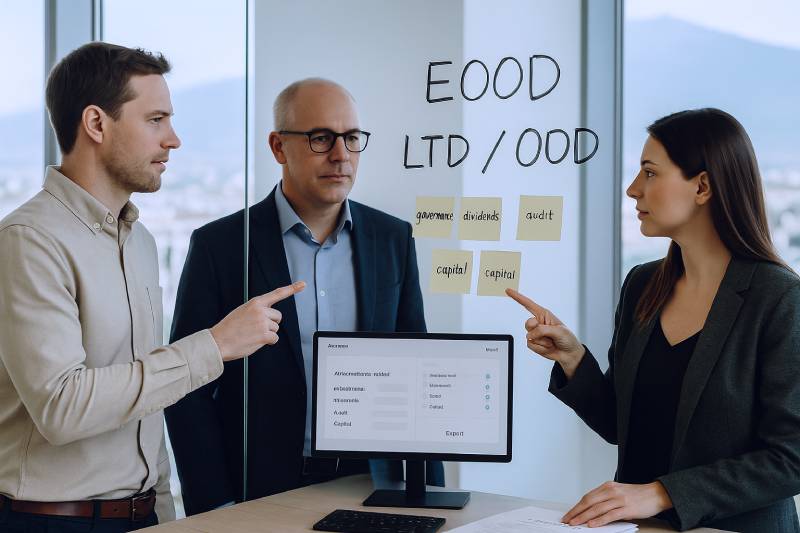

To choose between EOOD and LTD in 2026, decide if you want a single-owner company (EOOD) or a multi-owner limited company (LTD, legally OOD), compare decision-making and audit needs, check minimum capital, and plan bank, address, and yearly compliance before you register.
Key Takeaways
EOOD vs. LTD in Bulgaria: the short, practical answer
Both forms are Bulgarian limited liability companies. EOOD is owned by one person who also typically serves as director. LTD (OOD) has two or more owners whose rights are defined in the articles. Compliance and taxation are the same at the core; what changes is who approves decisions, how dividends are declared, and how fast you can sign and publish.
| Topic | EOOD (Single-Member LLC) | LTD / OOD (Multi-Member LLC) | Why It Matters |
|---|---|---|---|
| Owners | 1 owner (person or company) | 2+ owners with share ratios | Defines voting, exits, and dividends |
| Decision-making | Owner-director signs alone | Resolutions and board minutes | More partners = more governance steps |
| Liability | Limited to company assets | Limited to company assets | Personal assets ring-fenced |
| Minimum capital | Token capital possible | Token capital possible | Practice > theory for banks & VAT |
| Audit likelihood | Lower until thresholds | Higher at scale | Impacts deadlines and cost |
| Opening speed | Very fast (one signatory) | Fast, needs partner docs | Affects go-live date |
| Best fit | Solo founders, consultants, small e-commerce | Co-founders, investor-ready teams | Match structure to reality |
Decision framework: which structure fits your case?
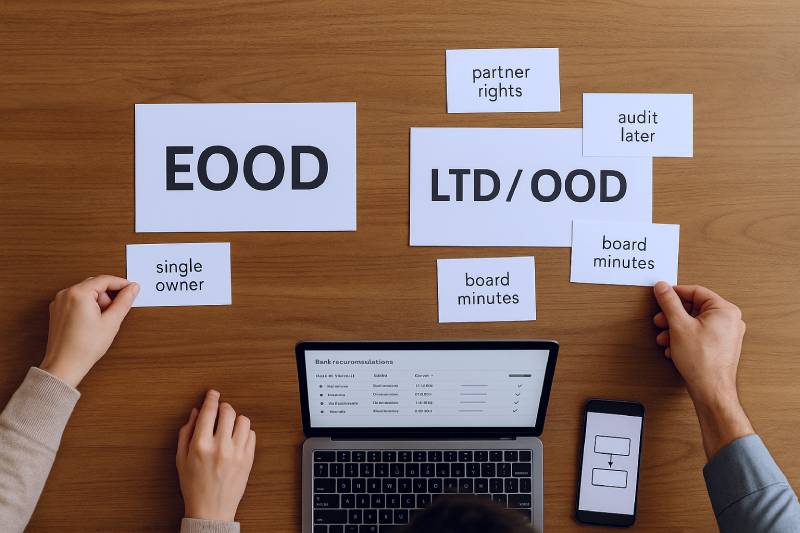
Pick the form that mirrors your current operations. If you work solo, EOOD keeps signatures fast and admin light. If you have co-founders or plan a board, LTD (OOD) gives you the structure to set rights and protect relationships.
| Scenario | Recommended Form | Why | What to Prepare |
|---|---|---|---|
| Solo founder selling services worldwide | EOOD | Fast signatures, simple governance | Director appointment; bank; invoicing stack |
| Two founders splitting equity | LTD / OOD | Shareholder rights and voting rules | Articles with rights; partner resolution templates |
| Startup raising investment soon | LTD now; plan AD/EAD later | Investors expect clear control & audit trails | Cap table; governance calendar; audit readiness |
| Foreign company entering Bulgaria | Branch or LTD (subsidiary) | Choose risk profile and branding | Parent docs; representative powers; local bank |
Ownership rules and governance basics
Shares, votes, and profit distributions
In an EOOD, you control distributions alone. In an LTD, dividends follow share ratios and special rights. Record minutes for each distribution. If investors come in, use reserved matters (e.g., issuing new shares, major contracts) to protect both sides.
Directors and signatory powers
Both forms appoint at least one director. LTDs often split powers between managing directors, or require joint signatures above a threshold. Get this right early to avoid payment bottlenecks: who initiates, who approves, and who signs filings.
Minimum capital in Bulgaria: what actually matters
Law allows very low capital for LLCs. Banks and clients, however, look at substance: a proper seat, a working website, and proof of activity. If you want practical numbers and examples, see the guide on minimum capital for Bulgarian companies and how much to allocate for a smooth start.
Address requirement & options
Every company needs a registered seat and address of service in Bulgaria. If you live abroad, use a professional address service and a digital mail workflow. Keep the seat contract in your document vault. Your accountant will use it for bank onboarding, audits, and year-end publication.
| Requirement | What It Means | Practical Options | Owner’s Task |
|---|---|---|---|
| Registered seat | Legal address on the register | Office lease, serviced office, address service | Sign seat contract and share with accountant |
| Service of notices | Official mail and filings | Forwarding + digital archive | Check monthly; upload scans |
| Board minutes (LTD) | Resolutions for key actions | Templates in your doc hub | Approve on time; keep versions |
Bank account process and payments
Bulgarian banks perform strong KYC. Prepare company documents, UBO IDs, and a short activity summary. After activation, enable roles and 2-factor logins. For banking rules and the payments framework, the Bulgarian National Bank provides oversight used by local banks.
| Step | What the Bank Checks | What You Provide | Outcome |
|---|---|---|---|
| Pre-screen | Activity, risk, owners | Website or deck; passport scans | Interview slot confirmed |
| KYC interview | Directors and UBOs | Articles, seat contract, UBO docs | Account approved pending checks |
| Activation | Security and user roles | e-banking users and limits | Payments live; feeds connected |
Remote setup: run everything from abroad
You can operate fully online: cloud ledger, bank feeds, receipt scanning, and e-signature for filings. Public filings appear in the Bulgarian Commercial Register. EU VAT frameworks (OSS, reverse charge) live on the European Commission portal—use them when selling across borders while keeping Bulgarian compliance intact.
| Tool | Why You Need It | Owner’s Action | Accountant’s Action |
|---|---|---|---|
| Cloud accounting | Bank feeds, VAT, VIES | Approve payments and docs | Reconcile and file |
| Document vault | Invoices, contracts, payroll | Upload weekly | Sample and archive |
| Qualified e-signature | Sign returns remotely | Authorize drafts | Prepare and submit |
Taxes and yearly compliance: what changes by form
Corporate tax and VAT rules are the same for EOOD and LTD. The difference is who approves and signs. LTDs may hit audit thresholds earlier as headcount and turnover grow. Filing processes and registrations are handled with the National Revenue Agency. If you want a step-by-step calendar of annual obligations (statements, publication, VAT/VIES), review yearly compliance obligations for Bulgarian companies and build your 2026 deadline plan now.
| Obligation | EOOD | LTD / OOD | Signing & Notes |
|---|---|---|---|
| Corporate income tax return | Director signs | Director(s) per articles | Same deadlines; different approvals |
| Annual financial statements | Owner-director approves | Partners’ resolutions needed | Audit if thresholds apply |
| Publication in register | Standard pack | Standard + resolutions | Published in Commercial Register |
| VAT & VIES (if registered) | Monthly returns | Monthly returns | OSS for EU B2C where relevant |
Residency, visas, and self-employment options
EU citizens register locally with fewer formalities. Non-EU founders often work under employment with their own company or a management contract. Once you pay yourself, payroll filings apply monthly and at year-end. If you stay founder-only with dividends, plan distributions with your accountant as part of the annual cycle.
| Path | When It Fits | Monthly Impact | Yearly Impact |
|---|---|---|---|
| Employment by your company | Active management and delivery | Payroll, social security | Annual payroll summaries |
| Management contract | Director services | Withholding taxes | Statements and reconciliations |
| Dividends only | Profit distributions | No monthly payroll | Declare distributions correctly |
Branches and representative offices
A branch is part of a foreign company and can trade and invoice in Bulgaria; a representative office cannot trade and focuses on marketing or research. If you plan to sell, register an EOOD/LTD or a Bulgarian subsidiary before issuing invoices.
| Aspect | Branch | Representative Office |
|---|---|---|
| Can issue invoices | Yes | No |
| Corporate income tax | Yes (local) | Limited |
| Annual publication | Local AFS extract | Limited admin |
| Payroll obligations | If employing locally | If employing locally |
Realistic costs and timelines
Costs depend on volume and whether you hit audit thresholds. Below are rounded, planning-level figures for 2026. Use them to set budgets and avoid year-end stress.
| Item | EOOD | LTD / OOD | Notes |
|---|---|---|---|
| Company formation (one-time) | 300–600 € | 400–800 € | Extra partner documents for LTD |
| Registered seat (yearly) | 100–200 € | 100–200 € | Depends on provider |
| Business bank account | 0–200 € | 0–200 € | KYC varies by bank |
| Accounting software (year) | 100–300 € | 100–300 € | English UI + VAT must-haves |
| Monthly accounting | 60–150 € | 100–250 € | More owners = more governance |
| Year-end closing & publication | 150–300 € | 300–600 € | Audit adds extra where required |
| Phase | EOOD | LTD / OOD | What Unlocks the Next Step |
|---|---|---|---|
| Prepare documents | 1–3 days | 3–5 days | Articles, seat contract, director IDs |
| Register company | 3–7 days | 3–7 days | Entry in Commercial Register |
| Open bank account | 3–10 days | 3–10 days | Pass KYC; activate e-banking |
| VAT registration (if needed) | 7–14 days | 7–14 days | Activity evidence to tax authority |
| Go live | — | — | Bank + invoicing + seat active |
Common pitfalls (and easy fixes)
- Choosing LTD “just in case.” If you are solo, EOOD is cleaner. You can add partners later without pain.
- No board minutes. LTDs need proper resolutions for distributions, director appointments, and filings.
- Late bank setup. Open early and connect feeds so VAT returns and reports are accurate.
- Messy document flow. Scan invoices at source and tag them; your accountant can file faster and avoid penalties.
- Ignoring yearly obligations. Put dates on a calendar and rehearse the workflow monthly so year-end is just another click.
What to do next (resources and expert help)
If you want a fast, low-stress start, begin with fast, secure and tax-optimized company registration in Bulgaria. If you’re still comparing Europe, see the reasons why Bulgaria is the best choice for company formation. When you’re ready to act, follow how to register your company in Bulgaria in 6 steps and budget using how much it costs to set up a company in Bulgaria. For day-to-day bookkeeping and filings, meet our accounting services firm in Bulgaria.
Book a free 30-minute consultation
Unsure which structure fits you? We’ll map your goals and give you a concrete plan for 2026. Book your free consultation and leave with a step-by-step checklist you can follow.
Frequently Asked Questions
Is EOOD the same as a single-member LTD?
Yes, to understand if EOOD is the same as a single-member LTD, know that EOOD is the Bulgarian term for a single-owner limited company and it provides the same limited liability.
Can I convert my EOOD into an LTD later?
Yes, to convert your EOOD into an LTD later, you add a partner and update the articles, then file the change so governance and signatures reflect the new ownership.
Do EOOD and LTD pay different taxes?
No, to compare taxes for EOOD and LTD, both follow the same corporate tax and VAT rules; the difference is who approves and signs filings.
Do I need a Bulgarian address if I live abroad?
Yes, to keep your company compliant while living abroad, you need a registered seat in Bulgaria and a reliable way to receive and archive official mail.
Is a representative office enough if I want to sell?
No, to sell and issue invoices, a representative office is not enough because it cannot trade; you need an EOOD, LTD, or a branch to bill clients.