To know what expenses are tax-deductible for Bulgarian companies, you include ordinary and necessary costs that are directly linked to earning business income—such as staff, office, software, travel, vehicles, marketing, professional services, and depreciation—while excluding or limiting personal, luxury, entertainment, and undocumented costs in 2026.
Deductible Expenses in Bulgaria—The Big Picture
Bulgarian corporate tax is calculated on taxable profit: revenue minus allowable expenses. The Ministry of Finance publishes the legal framework and changes; see the official resources at minfin.bg. If you’re new to the full calculation from revenue to tax due, read our simplified walk-through on how to calculate corporate tax in Bulgaria and the broader context in Bulgaria’s corporate tax rate overview.
| Expense Area | Typically Deductible | Not Deductible / Limited | Evidence to Keep | Founder Tip |
|---|---|---|---|---|
| Staff & payroll | Salaries, social security, benefits | Private gifts unrelated to work | Contracts, payroll reports, bank proof | Document bonuses with KPIs |
| Office & utilities | Rent, utilities, internet | Home rent without allocation | Lease, utility bills, policy | Use a fair % for mixed use |
| Software & SaaS | Productivity, dev tools, CRM | Personal streaming services | Invoices showing company details | Centralize licenses |
| Travel & subsistence | Transport, hotels, per-diems | Leisure, family tickets | Itinerary, receipts, policy | Attach meeting agenda |
| Vehicles | Lease, fuel, insurance (business part) | Private trips portion | Logbook, lease, fuel receipts | Keep a trip log |
| Marketing & sales | Ads, creatives, trade shows | Lavish entertainment | Contracts, invoices, photos | Separate client gifts & ads |
| Professional services | Accounting, legal, audit | Personal legal matters | Engagement letter, invoices | Scope the engagement |
| Depreciation | Equipment, furniture, hardware | Private devices with no business link | Asset register, invoice, usage | CapEx vs OpEx rules apply |
How the EU VAT Framework Interacts with Your Expenses
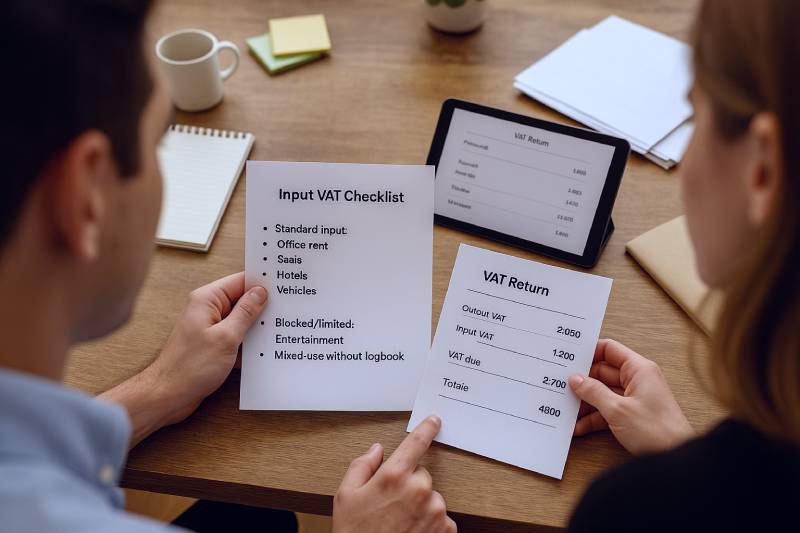
VAT rules are harmonized at EU level. On your expenses, input VAT is normally reclaimable if the cost is used for taxable business activities and not explicitly blocked. For authoritative guidance and cross-border rules, consult the European Commission VAT pages, and the legal base in the EU VAT Directive on EUR-Lex. Domestic administration and forms are handled by the National Revenue Agency.
| Expense | Input VAT Position | Condition | What to File/Keep | Common Error |
|---|---|---|---|---|
| Office rent & utilities | Usually reclaimable | Registered for VAT and taxable use | VAT invoice, lease | Forgetting to update address |
| Software subscriptions | Reclaimable | Business use and valid invoice | VAT invoice, contract | Using personal email/accounts |
| Travel & hotels | Varies by country & purpose | Business trip, evidence required | Itinerary, receipts, agenda | No link to revenue activity |
| Entertainment & gifts | Often blocked or limited | Modest gifts may be allowed | Gift policy, receipts | Calling entertainment “marketing” |
| Vehicles | Partially reclaimable | Business usage % recorded | Logbook, fuel receipts | No usage split recorded |
Deep-Dive: The Most Common Deductible Categories
1) Staff Costs
Salaries, social security, mandatory insurance, and performance bonuses are deductible when paid for work that produces income. Non-business gifts and private benefits are not.
2) Office, Utilities, and Registered Address
Rent, service charges, electricity, water, internet, and cleaning are deductible if tied to your operations. For mixed-use (e.g., home office), apply a reasonable business percentage based on area or time.
3) Software, Cloud, and Tools
Licenses for productivity, CRM, analytics, dev tools, storage, and cybersecurity are deductible. Keep your company data on each invoice and centralize subscriptions.
4) Travel, Per-Diems, and Client Meetings
Plane/train/bus tickets, mileage for business journeys, hotels, and reasonable meals are deductible when trips have a clear business agenda. Leisure and companion costs are not.
| Cost Type | Deductible? | Evidence | Founder Tip |
|---|---|---|---|
| Transport (air/rail/road) | Yes, business trips | Tickets, itinerary, meeting notes | Attach calendar invites |
| Hotels | Yes, reasonable | Hotel invoice with company data | Prefer B2B invoices |
| Meals | Limited/Reasonable | Receipt + attendee/purpose | Use a simple meal policy |
| Leisure, companion | No | — | Split personal costs |
5) Vehicles—Company vs Mixed Use
For company cars, deduct lease, insurance, maintenance, and fuel proportionate to business use. For mixed usage, keep a logbook and apply a fair split. Private trips are not deductible.
| Approach | When to Use | What You Deduct | Evidence | Risk |
|---|---|---|---|---|
| Company car | Dedicated business use | Lease, fuel, insurance, repairs | Lease, invoices, logbook | Private use must be minimal |
| Mixed-use allocation | Owner-driver, occasional trips | Business % of all costs | Logbook, trip purpose | Weak logs → disallowances |
6) Marketing, Sales, and Partnerships
Performance ads, creatives, SEO tools, sponsorships linked to revenue, trade-show fees, and samples are deductible. Lavish entertainment is not.
7) Professional Services & Compliance
Accounting, legal, payroll, audit, and compliance subscriptions are deductible when tied to the business. Private legal matters are not.
8) Equipment, CapEx, and Depreciation
Hardware, furniture, and larger tools may be capitalized and depreciated over useful life. Small tools and supplies are usually expensed. Keep an asset register for clarity.
9) R&D, IP, and Bad Debts
Research costs, prototyping, patent filings, and technical documentation are deductible when they support the business. Write-offs for uncollectible invoices may be deductible if you show reasonable attempts to collect.
Remote Founders, Cross-Border Expenses, and Evidence
Remote EOOD/OOD owners can run everything paperless: collect e-invoices, bank statements, and delivery proof; mirror the language and currency in your ledger (EUR is fine). Cross-border expenses need extra care on VAT and place-of-supply rules. Legal bases and updates live on EUR-Lex, while Bulgarian practice and forms are administered through NRA portals.
| Expense | Place of Supply (Typical) | VAT Outcome | What to Keep | Founder Tip |
|---|---|---|---|---|
| EU software (B2B) | Customer location | Reverse charge, no foreign VAT | Supplier VAT, your VAT/EIK | Check the invoice has your VAT ID |
| Non-EU SaaS | Customer location | May charge local tax outside EU | Invoice, tax line if any | Capture supplier tax status |
| Hotels abroad | Where the hotel is located | Local VAT may be non-reclaimable | Hotel invoice, itinerary | Focus on profit deduction, not VAT |
| Freelancers abroad | Supplier’s country or your location | No VAT if reverse-charged | Contract, invoice, bank proof | Collect tax residence statements |
Company Form, Ownership, and Practical Differences
EOOD (single-owner OOD), OOD (multi-owner), EAD (single-owner JSC), and AD (JSC) all follow the same core logic for deductibility. Differences show up in governance, audits, equity plans, and access to investment—not in whether a cost is ordinary and necessary.
| Form | Owners | Governance | Payroll/Director Pay | Deductibility Impact | Use Case |
|---|---|---|---|---|---|
| EOOD | 1 | Director managed | Owner-director remuneration | Same rules as OOD | Solo founders |
| OOD | 2+ | Shareholder agreements | Director contracts | Same rules as EOOD | Agencies, studios |
| EAD | 1 | Board/sole director | Board-approved packages | No change on what’s deductible | Scale-up prep |
| AD | 2+ | One/two-tier board | Remco, audit committee | Audit may increase scrutiny | Investor-ready companies |
Documentation: Your Audit-Ready Checklist
Auditors look for a clear link from expense to revenue activity, and for consistent, complete documentation month by month.
| Expense | Mandatory Documents | Optional but Helpful | Retention Habit |
|---|---|---|---|
| Payroll | Employment contracts, payroll sheets | KPIs, bonus memos | Store monthly packs |
| Rent & utilities | Lease, invoices, bank proofs | Photos of signage/workspace | Renewals filed annually |
| Software/SaaS | Invoices with company data | License assignments | Centralize vendors |
| Travel | Receipts, itinerary | Meeting agenda, minutes | Attach to claim |
| Vehicles | Lease, insurance, fuel receipts | Logbook records | Weekly updates |
| Professional services | Engagement letter, invoices | Work reports | Quarterly review |
Worked Examples—How Deductions Change Your Taxable Profit
Below are simplified scenarios to show how smart documentation and categorization reduce taxable profit (numbers rounded, VAT excluded for clarity).
| Line Item | Consulting EOOD | E-commerce OOD |
|---|---|---|
| Revenue | 240,000 | 600,000 |
| Payroll & contractors | 90,000 | 180,000 |
| Office & software | 18,000 | 24,000 |
| Marketing & sales | 12,000 | 120,000 |
| Travel & vehicles | 8,000 | 12,000 |
| Professional services | 6,000 | 10,000 |
| Depreciation | 4,000 | 8,000 |
| Total deductible expenses | 138,000 | 354,000 |
| Taxable profit | 102,000 | 246,000 |
Monthly Rhythm—Never Miss a Deduction Again
Close your books monthly, reconcile bank feeds, and label every transaction. That’s the easiest way to avoid missed deductions and to prepare for VAT and year-end filings.
| When | Action | Output | Result |
|---|---|---|---|
| Week 1 | Collect invoices & receipts | Complete document pack | Audit-ready evidence |
| Week 2 | Reconcile bank & wallets | Clean ledger | Fewer errors |
| Week 3 | Review VAT eligibility | Input VAT schedule | Correct VAT returns |
| Week 4 | Management snapshot | Mini P&L | Faster decisions |
Common Pitfalls—and Simple Fixes
| Mistake | What Goes Wrong | Fix |
|---|---|---|
| Mixing personal & business | Disallowed costs, audit risks | Separate cards & policies |
| No documentation | Deduction rejected | Keep invoice + proof of use |
| Ignoring VAT rules | Lost input VAT or penalties | Check eligibility monthly |
| Weak vehicle logs | Business % disallowed | Use a simple trip log |
| Late closings | Missed expenses | 4-week close routine |
Set Up Right from Day One
Starting now saves tax and time later. If you want an A-to-Z partner for setup and compliance, we offer fast, secure and tax-optimized company registration in Bulgaria. For strategic reasons to pick Bulgaria, review why Bulgaria is a strong formation base. To see how the registration actually works, follow the six-step company registration process, and for budgeting the launch itself, check the true cost to set up a company. Ready to outsource the monthly work? Our accounting services in Bulgaria keep your ledgers clean, match VAT rules, and catch every eligible deduction.
Talk to Us—Free 30-Minute Call
Tell us what you sell, where your clients are, and which costs you carry. We’ll map deductions, VAT eligibility, and a clean monthly workflow you can follow in 2026. Book your free 30-minute consultation and stop leaving money on the table.
Frequently Asked Questions
Do software subscriptions count as deductible expenses in Bulgaria?
Yes, software subscriptions count as deductible expenses in Bulgaria, because business-use SaaS and licenses are ordinary and necessary costs when documented with proper invoices.
Do meals and entertainment qualify as deductible business costs?
Yes, meals can qualify as deductible business costs in Bulgaria if they are reasonable and directly linked to business activity, but entertainment is often limited or disallowed, so you should separate the two with a clear policy.
Do vehicle costs become deductible if I use my car for business trips?
Yes, vehicle costs become deductible if you use your car for business trips in Bulgaria, because you can deduct the business portion when you keep a trip log and allocate mixed use fairly.
Do hotel and flight expenses qualify if I combine a client meeting with a short holiday?
No, the holiday portion does not qualify if you combine a client meeting with personal time, because only the business-related segment is deductible and must be supported by evidence.
Do I need VAT registration to deduct expenses for corporate tax purposes?
No, you do not need VAT registration to deduct expenses for corporate tax purposes in Bulgaria, because profit-tax deductibility is separate from VAT status, although VAT registration affects input VAT recovery.