

To transition from freelancer to LTD in Bulgaria in 2026, you create an EOOD (single-owner LTD), keep your freelance activity running until the company is live, open a corporate bank account, decide VAT treatment before your first company invoice, and switch clients to bilingual contracts and invoices in an organized, step-by-step flow.
Key Takeaways
The easiest path from freelancer to a Bulgarian LTD (EOOD): overview
Most established freelancers choose EOOD to keep control and move fast. You retain your current clients while preparing the company, then switch billing once the corporate IBAN and VAT position are confirmed. If you want to sanity-check the economics first, compare scenarios in this practical overview of freelancing vs registering a company for tax.
| Step | Who Leads | Core Documents | Where It’s Filed/Used | Typical Duration |
|---|---|---|---|---|
| 1. Incorporation pack | You + consultant | ID, address proof, activity brief, PoA (if remote) | e-government filing | 2–5 days |
| 2. Corporate bank account | You + accountant | KYC folder (IDs, UBO chart, contracts) | Bank meeting | 5–10 days |
| 3. VAT decision | Accountant | Client mix, markets, OSS/IOSS choice | Tax registration | 5–10 days |
| 4. Templates & tools | You + accountant | Bilingual invoices, contract addenda | Operations | 1–3 days |
| 5. Client migration | You | New details, VAT notes, IBAN | Client onboarding | Phased (1–4 weeks) |
Prefer a single team to orchestrate filings, KYC, VAT, and monthly accounting? We deliver fast, secure and tax-optimized company registration in Bulgaria with bilingual templates and a clean monthly routine.
EOOD vs OOD vs EAD vs AD: picking the right form for your transition
Start lean with EOOD. If co-founders join, you can transform to OOD; if investors join, you may upgrade to a joint-stock (EAD/AD). This choice affects governance, banking, audits, and how you pay yourself.
| Form | Best For | Ownership & Control | Compliance Load | Upgrade Path | Typical Pitfall |
|---|---|---|---|---|---|
| EOOD (single-owner LTD) | Solo freelancers incorporating | 1 owner; manager minutes | Low–Medium | → OOD when partners arrive | No minute book for dividends |
| OOD (multi-owner LTD) | Two+ partners, studio teams | Share quotas; assemblies | Medium | → AD for investors | Vague shareholder agreement |
| EAD (single-shareholder JSC) | Holdings/scale-ups | Board structure; secretary records | Medium–High | ↔ AD as cap table grows | Underestimating audit cadence |
| AD (joint-stock) | Investor-ready growth | Many shareholders; formal boards | High | Capital markets later | Cap-table discipline gaps |
Need a step-by-step for the most popular route? See this focused guide to EOOD registration for foreign founders so you can prepare the exact documents and signatures in the right order.
Address, bank account, and VAT: what changes when you become an LTD
Authorities and banks will expect a registered address, clear business description, and consistent documents. You can track publication in the Bulgarian Commercial Register, submit via the Bulgarian e-Government company portal, align cross-border VAT with the European Commission frameworks, and handle tax administration with the National Revenue Agency.
| Item | What Changes After LTD | Proof/Record | Where to Verify/Align | Speed Tip |
|---|---|---|---|---|
| Registered address | Filed and public | Lease/virtual office agreement | Commercial Register | Nominate a mail custodian |
| Corporate bank account | IBAN for company | KYC pack (IDs, UBO, activity) | Bank onboarding rules | One-folder KYC PDF |
| VAT decision | Domestic VAT / B2B RC / OSS | VAT certificate; invoices | EC VAT frameworks; NRA filings | Decide before first invoice |
| Minute book | Board/owner decisions | Signed resolutions | Internal register | Template set for dividends/changes |
Remote setup in 2026: how the process actually flows
You can complete everything remotely with a power of attorney and bilingual templates. Keep signatures and IDs consistent across filings, bank, and VAT. Plan each phase in days, not “asap.”
| Phase | Main Actions | Expected Duration | What Can Slow You Down | How to Stay Fast |
|---|---|---|---|---|
| Prep | Collect IDs, address proof, activity brief; sign PoA | 3–7 days | Missing scans; inconsistent names | One KYC folder; name format lock |
| Incorporation | File company; manager appointment | 2–5 days | Incorrect forms | Bilingual templates |
| Bank onboarding | UBO chart; expected flows; website brief | 5–10 days | Vague activity description | One-page business model |
| VAT | Domestic/OSS decision; evidence rules | 5–10 days | Late documentation | Decide pre-invoice |
| Go-live | Bilingual invoices; client migration | Immediate | Ad-hoc switching | Batch clients; communicate dates |
Costs in euros: one-off and monthly after you switch
Think in total-cost terms, not tax alone. Budget setup (legal, translations), monthly accounting, payroll if you pay yourself as a director, and year-end publication.
| Item | One-Off | Monthly | Notes |
|---|---|---|---|
| EOOD setup (filing + docs) | 600–1,200 | — | Varies with signatures/translations |
| Accounting service | — | 120–300 | Volume and VAT complexity |
| Payroll service (per employee/director) | — | 30–80 + contributions | Only if you put yourself on payroll |
| Registered address (virtual/co-working) | — | 20–150 | Upgrade to small lease as you grow |
| Annual accounts & publication | 200–500 | — | Plan ahead to avoid rush fees |
Migrating clients without drama: contracts, invoices, and tools
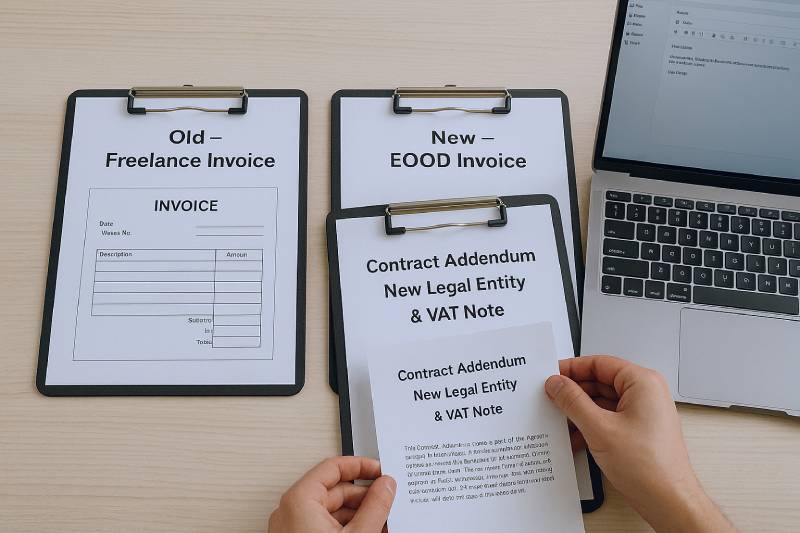
Tell clients about your change two weeks in advance. For retainers, use a short addendum that updates legal identity, VAT note, and IBAN. For projects, switch at the next milestone. Keep freelancer invoices separate from company invoices for clean accounting.
| Client Type | When to Switch | Documents to Send | Invoice Notes | Risk to Avoid |
|---|---|---|---|---|
| Monthly retainer | Next billing cycle | Addendum with new legal details | VAT note; new IBAN | Dual billing in same period |
| Fixed-fee project | Next milestone | Short contract update | Place-of-supply logic clear | Wrong VAT rate |
| Platform clients | Case-by-case | Profile/legal detail update | Follow platform invoice fields | Breaking T&Cs |
Branches & representative offices: when they are (not) useful
If you already run a foreign company, you might consider a Bulgarian branch to invoice locally while keeping HQ identity. A representative office cannot trade; it is for research and hiring admin only. Most freelancers do not need these—an EOOD is simpler and faster.
| Structure | Can Trade? | Admin Load | Best For | Key Risk |
|---|---|---|---|---|
| Branch of foreign company | Yes (as HQ) | Medium | Existing corporate migrating work | Mismatched HQ/local ledgers |
| Representative office | No (non-trading) | Low–Medium | Market research, early hiring | Accidental invoicing |
| Local company (EOOD/OOD) | Yes | Low–High (by size) | Freelancers scaling into a studio | Wrong VAT logic at launch |
Residency, visas, and work permissions
Owning a Bulgarian company does not itself grant residency. EU citizens can live and work with registration formalities; non-EU nationals need a separate permit strategy (e.g., management contracts, highly-skilled routes, or investor pathways). Treat immigration as its own project with timelines separate from tax or incorporation.
Avoid these pitfalls when you switch to LTD
| Mistake | Impact | Fix |
|---|---|---|
| English-only invoices | Rejections, VAT confusion | Use bilingual templates with correct VAT notes |
| Late VAT decision | Retroactive liabilities | Decide before first company invoice |
| Unmonitored address | Missed notices, penalties | Nominate a mail custodian; weekly scans |
| No minute book | Bank blocks dividends/changes | Keep signed resolutions for key events |
| Merging freelance & company records | Messy audits, delays | Separate folders; reconcile monthly |
Who we are and how we help
We specialize in moving established freelancers into clean, bank-friendly Bulgarian companies and keeping the monthly rhythm effortless. Learn the reasons Bulgaria is a smart place to form a company, and when you’re ready to execute, follow the six practical steps to register with the right documents lined up. For ongoing ledgers, VAT, and payroll, explore our accounting services in Bulgaria and stay audit-ready from month one.
Want a precise, personal roadmap for your numbers and client mix in 2026? Book your free 30-minute consultation and we’ll map your sequence, documents, and migration plan.
Also useful as you plan your structure change: this focused guide to how much it costs to set up a company in Bulgaria helps you budget the first year realistically.
Frequently Asked Questions
Do I need to close my freelance activity before creating an EOOD?
No, you do not need to close your freelance activity before creating an EOOD; to avoid gaps you can keep freelancing until your company bank account and VAT position are ready, then switch clients in batches.
Will I get a VAT number immediately after incorporation?
No, you will not get a VAT number immediately after incorporation; to obtain it your accountant must apply based on your activity and markets, and you should wait for approval before issuing VAT-relevant invoices.
Can I open the corporate bank account completely remotely?
Yes, you can open the corporate bank account mostly remotely in many cases, but to finalize onboarding some banks require a brief identity step, so plan a video verification or short visit if asked.
Should I pay myself a salary or only dividends from the LTD?
No, you should not rely only on dividends from the LTD; to balance tax and benefits you typically combine a modest salary or management pay with distributions aligned to your cash flow.
Will owning an LTD grant me residency in Bulgaria?
No, owning an LTD will not grant you residency in Bulgaria; to live and work long-term you need to pursue the appropriate visa or permit independently of company ownership.