

To decide whether you need an accountant as a freelancer in Bulgaria in 2026, you look at the complexity of your invoices and VAT, your social and health contributions, the risk of penalties for late or wrong filings, and your growth plans—if your activity stays simple and local you can DIY with discipline, but once you sell cross-border, register for VAT, or prepare for a company (EOOD), hiring a Bulgarian accountant saves time, money, and stress.
Key Takeaways
Do freelancers in Bulgaria need an accountant? The honest answer
You don’t always need one. Many new freelancers start alone, especially with a handful of domestic clients and a simple expense stack. But as soon as business gets cross-border or recurring, the margin you think you save by going solo can evaporate in errors, re-issued invoices, or missed deadlines. To understand your obligations and how they combine in practice, start here: Bulgaria self-employed taxes explained.
| Situation | DIY Feasible? | Risk If You DIY | When to Hire |
|---|---|---|---|
| Few local B2B invoices, no VAT | Yes, with checklists | Late returns, missing records | When volume or travel increases |
| EU B2B services (reverse charge) | Maybe | Wrong VAT notes, penalties | Immediately |
| EU B2C digital services (OSS) | Hard | Wrong rate, bad evidence | Immediately |
| Preparing to form an EOOD | Possible | Bank/VAT delays | Before first company invoice |
What a Bulgarian accountant actually does for a freelancer
A good accountant is more than “someone who files a return.” They design a monthly rhythm, keep your bilingual paperwork tidy, and make sure the National Revenue Agency submissions line up with reality. They also bridge language and process gaps. If you want to streamline how you exchange information and avoid misunderstandings, these communication tips for working with Bulgarian accountants will help from day one.
| Area | DIY Tasks | Accountant Tasks | Why It Matters |
|---|---|---|---|
| Invoicing | Create invoice, collect payments | Check VAT notes, numbering, client VAT | Prevents re-issuing and fines |
| VAT | Track thresholds | Register/dergister, OSS, reverse charge logic | Correct tax at the right place |
| Contributions | Pay social & health | Set insurance base, schedule payments | No gaps that affect benefits |
| Books & records | Save receipts | Post to ledgers, reconcile bank | Evidence for audits and refunds |
| Year-end | Prepare files | Annual accounts and publication support | Stops last-minute chaos |
Compliance pillars to stay safe (even if you DIY)
Whether or not you hire help, a consistent monthly routine is non-negotiable. Follow the official frameworks and tools, and you’ll avoid avoidable penalties.
- Tax & contributions: align with the National Revenue Agency procedures.
- EU VAT logic: study the place-of-supply rules and special schemes on the European Commission site.
- e-Government filings: use the official company and services portal at psc.egov.bg when you need to register an entity or make changes.
| Cycle | Your Checklist | Common Pitfall | Pro Tip |
|---|---|---|---|
| Monthly | Issue invoices, save statements, pay contributions | Catching up at year-end | Submit docs by the 5th each month |
| Quarterly | Review VAT position, profitability | Late VAT registration | Decide VAT before cross-border sales |
| Year-end | Accounts, returns, publication support | Missing evidence for expenses | Keep a receipts folder by month |
How much does an accountant cost (and what’s the ROI)?
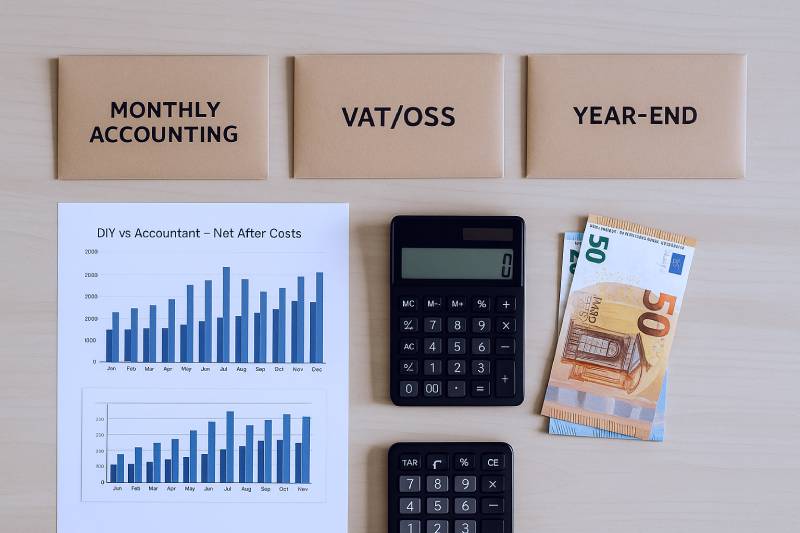
Rates vary by volume, VAT needs, and whether you also want payroll or representation. Think in total cost, not just a monthly invoice: how many hours do you save, and what errors do you prevent?
| Service Level | What’s Included | Monthly Fee | Who It Fits |
|---|---|---|---|
| Starter | Invoices check, contributions reminders | 80–120 | Local services, low volume |
| EU Services | Reverse charge/OSS advice, VAT reports | 120–200 | Cross-border B2B or B2C |
| Growth | Forecasting, quarterly reviews, audit-ready archive | 200–300 | Steady clients, preparing for EOOD |
If you want a simple way to budget your first year (including entity costs if you plan to incorporate), this guide to how much it costs to set up a company in Bulgaria gives you realistic ranges to plan in euros.
When to consider switching to a company (EOOD) instead of staying freelance
Past a certain point, a company is cleaner: limited liability, stronger banking, clearer VAT control, and a more professional face for B2B clients. You can verify published company details at the Bulgarian Commercial Register, and if you need a refresher on why Bulgaria is attractive for formation, see these reasons why Bulgaria is a strong choice for company formation.
| Trigger | Stay Freelance | Move to EOOD | Reason |
|---|---|---|---|
| Domestic ad-hoc projects | Yes | No | Simple admin, low risk |
| Recurring EU B2B retainers | No | Yes | Client trust and VAT logic |
| Hiring or subcontracting | No | Yes | Payroll and liability |
| Scaling brand & payments | No | Yes | Corporate IBAN and tooling |
When your numbers point to a company, follow a clear sequence so you don’t lose momentum. Here’s a practical checklist for registering your company in Bulgaria in 6 steps.
Remote setup, address, and banking: what freelancers should know
Most steps can be handled remotely with a power of attorney and standard templates. Keep your registered address monitored and your bank KYC pack in a single PDF (IDs, activity brief, contracts). If you want a turnkey formation with post-incorporation support, we offer fast, secure and tax-optimized company registration in Bulgaria backed by a monthly routine that keeps you audit-ready.
| Item | What You Provide | Typical Timing | Speed Tip |
|---|---|---|---|
| Registered/Reachable address | Lease or virtual office confirmation | 2–5 days to file or update | Nominate a mail custodian |
| Corporate bank account | KYC pack with UBO and activity | 5–10 days | One-page business model for the bank |
| VAT position | Place-of-supply map; OSS if needed | 5–10 days to register | Decide before the first invoice |
Real-world scenarios: DIY or hire?
- Scenario 1 — Local designer, a few invoices per month: DIY is fine, but set firm monthly reminders. Reassess if you start selling to EU clients.
- Scenario 2 — EU B2B consultant with retainers: Hire an accountant now; reverse charge notes and evidence must be right every month.
- Scenario 3 — Creator selling digital products to EU consumers: Hire an accountant to configure OSS and keep location proofs tidy.
- Scenario 4 — Preparing to incorporate: Bring an accountant in before you file; they coordinate registry, bank KYC, VAT, and the first month’s templates.
Who we are and how we help
We help freelancers set a clean routine (invoices, VAT notes, contributions) and, when the time is right, move to an EOOD without disruption. Learn about our accounting services in Bulgaria if you want monthly peace of mind from the start.
Book your free 30-minute consultation and get a simple plan for your activity in 2026—DIY checklists if you stay solo, or end-to-end support if you’re ready to grow.
Frequently Asked Questions
Do I need an accountant as a freelancer in Bulgaria if I have only a few local clients?
No, you do not need an accountant as a freelancer in Bulgaria if you have only a few local clients, but to stay compliant you must follow a strict monthly routine for invoices, records, and contributions.
Should I hire an accountant when I start invoicing EU clients with reverse charge?
Yes, you should hire an accountant when you start invoicing EU clients with reverse charge, because to avoid penalties you must apply the correct VAT wording and keep proper evidence.
Do I need an accountant to register for VAT or use OSS for EU B2C sales?
Yes, you need an accountant to register for VAT or use OSS for EU B2C sales, because to comply you must set the right VAT rates and store customer location proofs consistently.
Can I switch from freelance to an EOOD without an accountant?
Yes, you can switch from freelance to an EOOD without an accountant, but to keep it smooth you should have expert help for registry filing, bank KYC, and VAT registration before your first invoice.
Will an accountant pay for themselves if I plan to scale in 2026?
Yes, an accountant will often pay for themselves if you plan to scale in 2026, because to save time and avoid re-issuing documents they set correct VAT, contributions, and monthly routines from day one.