

To decide whether it’s better to use Upwork or your own Bulgarian company for clients in 2026, you compare total cost (platform fees + taxes), credibility and control (who owns the relationship, invoicing, VAT), and practicalities (banking, compliance, and growth); for early, sporadic projects Upwork can be simpler, while for steady income, B2B clients, and scaling, a Bulgarian company (usually EOOD) typically wins overall.
Key Takeaways
Upwork vs your own Bulgarian company: quick answer and who each option fits
Upwork is great when you want speed, built-in client discovery, and escrow. Your own company shines when your pipeline is stable, clients are mid-to-large B2B, or you want to capture platform margin and build a brand. If you’re still torn, this deep-dive comparison of freelancing vs registering a company for tax will help you run the numbers for 2026.
| Factor | Upwork (as freelancer) | Your Bulgarian Company (EOOD/OOD) | What Tips the Scale |
|---|---|---|---|
| Start speed | Immediate | 2–5 days to incorporate | If you need revenue today, Upwork wins |
| Fees vs margin | Platform service fees apply | No platform fee; pay admin costs | At steady income, company margins improve |
| VAT & invoicing control | Constrained by platform workflow | Full control of templates, VAT logic | Cross-border B2B/B2C rules favor a company |
| Client trust | Platform profile acts as reference | Corporate brand, contracts, website | B2B clients prefer corporate invoices |
| Scale & hiring | Solo focus | Hire, subcontract, payroll | Teams and growth favor a company |
Taxes, platform fees, and real costs: model your true net
Don’t compare tax in isolation. Add platform fees, accounting, payroll, and annual filings. For invoicing specifics, set up compliant templates early using how to send compliant invoices in Bulgaria so you avoid re-issuing documents later.
| Item | Upwork Path | Own Company Path (EOOD/OOD) | Notes |
|---|---|---|---|
| Platform fee | Applies to each job | None | Company path captures margin but adds admin |
| Setup (one-off) | 0–200 | 600–1,200 | Company: registry and legal costs |
| Accounting (monthly) | 80–150 | 120–300 | Volume/VAT drive price |
| Payroll service (per employee) | — | 30–80 + contributions | If you hire or pay director |
| Annual accounts/publication | 120–250 | 200–500 | Publish on time to avoid penalties |
Credibility, payment speed, and client control
Platforms provide escrow and ratings; companies provide brand, contracts, and direct banking. With your own entity, you present a corporate profile and negotiate payment terms (e.g., 30–40% up-front). For a strategy overview of why this matters in Bulgaria, review the reasons why Bulgaria is a strong company-formation base.
| Aspect | Upwork | Your Company | Practical Outcome |
|---|---|---|---|
| Trust signal | Ratings and reviews | Corporate brand + references | Enterprises prefer company invoices |
| Payment control | Escrow, dispute center | Contractual milestones, direct wiring | Fewer intermediaries with a company |
| Invoicing | Platform workflow | Bilingual templates + VAT logic | Cleaner audits and exports |
Ownership rules and company types (EOOD, OOD, AD, EAD)
Choose form by partners, governance, and funding path. You can transform later (EOOD→OOD or OOD→AD/EAD) when investors arrive. If you already know a company is right, here’s a practical view of how much it costs to set up a company in Bulgaria to budget your first year.
| Form | Best For | Ownership | Compliance Load | Upgrade Path |
|---|---|---|---|---|
| EOOD (single-owner LTD) | Solo founders | 1 owner | Low–Medium | EOOD → OOD (add partners) |
| OOD (multi-owner LTD) | Co-founders | 2+ owners | Medium | OOD → AD (investor-ready) |
| EAD (single-shareholder JSC) | Holdings/scale-ups | 1 shareholder | Medium–High | EAD ↔ AD for larger investor base |
| AD (joint-stock) | Larger teams/investors | Many shareholders | High | Public markets readiness later |
Address, bank account, and substance: what both routes must respect
Whether you earn via Upwork or your own contracts, authorities and banks expect real substance: a reachable address, accurate records, and a clear business description. Company addresses and changes are visible in the Bulgarian Commercial Register. For general tax administration (self-employed and companies), align with the National Revenue Agency.
| Item | Upwork Path | Own Company Path | Speed Tip |
|---|---|---|---|
| Registered/Reachable address | Lease or co-working proof | Filed registered address | Scan contracts and utility proofs |
| Bank account & KYC | Personal business account | Corporate IBAN + UBO docs | One-folder KYC pack (IDs, activity brief) |
| Records | Invoices and statements | Ledgers, minutes, registers | Monthly “document drop” by the 5th |
Remote setup and e-government: your timeline in 2026
You can incorporate and operate remotely with powers of attorney and bilingual templates. Public portals streamline submissions when documents are complete and consistent. To understand formalities at a glance, browse the Bulgarian e-Government company portal for official processes.
| Phase | Main Actions | Typical Duration | How to Stay Fast |
|---|---|---|---|
| Prep | PoA (if remote), address, activity brief | 3–7 days | Collect documents before filing |
| Incorporation | Registry filing & approval | 2–5 days | Error-free forms and signatures |
| Bank & VAT | KYC, decide VAT/OSS | 5–15 days | Complete KYC pack; VAT plan before invoicing |
| Go-Live | Issue invoices; monthly routine | Immediate | Bilingual templates ready on day one |
VAT and invoicing on and off platforms
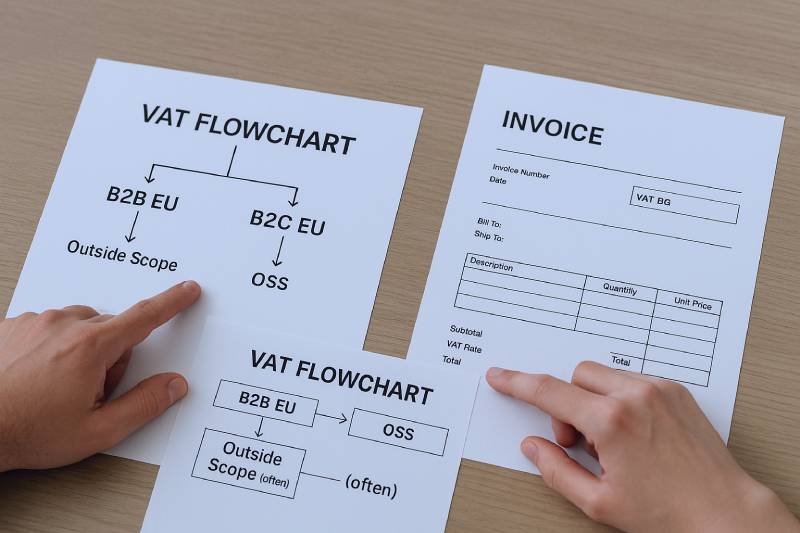
On platforms, some VAT fields are constrained; off-platform, you control place-of-supply and evidence collection for EU B2B/B2C. Align your logic and keep proofs of customer location where needed. The European Commission outlines the EU VAT frameworks that apply to cross-border services and e-commerce.
| Scenario | Typical VAT Position | What to Put on the Invoice | Evidence You Keep |
|---|---|---|---|
| B2B services (EU client) | Reverse charge (often) | Client VAT; “Reverse charge” note | Client VAT number + contract |
| B2C digital services (EU) | OSS; destination VAT | Local VAT rate per destination | Two proofs of customer location |
| Non-EU client | Outside scope (often) | Zero VAT line, correct wording | Contract + payment and location proof |
Branches and representative offices: do they help freelancers?
If you already operate a foreign company, a Bulgarian branch lets you invoice locally with accounting aligned to HQ. A representative office can hire but cannot trade; it’s for marketing and research only. Pure freelancers rarely need these unless migrating an existing corporate structure.
| Structure | Can Trade? | Admin Load | Best For | Key Risk |
|---|---|---|---|---|
| Branch of foreign company | Yes (as HQ) | Medium | Existing corporate ops entering BG | Mismatched HQ vs local ledgers |
| Representative office | No (non-trading) | Low–Medium | Market research, early staffing | Accidental invoicing |
| Local company (EOOD/OOD) | Yes | Low–High (by size) | Most SMEs and e-commerce | Incorrect VAT from day one |
Real-world scenarios: when each option clearly wins
- New freelancer, unpredictable gigs: Upwork wins. You value speed and escrow more than margin. Reassess when income stabilizes.
- Mid-size B2B retainers, recurring work: Your company wins. You keep platform margin, control VAT, and negotiate better terms.
- Team of subcontractors: Company wins. Payroll and contracting are easier, and clients take you more seriously.
- High-ticket, enterprise buyers: Company wins. Procurement prefers corporate invoices and compliance documentation.
How to switch: from platform-first to your own company
Once your pipeline is stable and margins matter, moving to a company is straightforward. When you’re ready to execute, follow how to register your company in Bulgaria in 6 steps and prepare your first-month toolkit (VAT plan, invoice templates, bank flows).
| Step | What You Prepare | Where It’s Used | Outcome |
|---|---|---|---|
| 1. Choose legal form | EOOD for solo; OOD for partners | Planning | Governance & tax aligned |
| 2. Incorporation pack | IDs, address, PoA if remote | Registry submission | Company number |
| 3. Bank onboarding | KYC pack, UBO chart | Bank meeting | Corporate IBAN |
| 4. VAT decision | Client mix, EU/non-EU, OSS | Tax registration | Correct VAT from day one |
| 5. Go-live | Bilingual invoice templates | Operations | First compliant invoices |
Who we are and how we help
We help digital freelancers shift from platform-only to a structure that makes sense for margins and growth. If you stay on Upwork, we’ll keep your records clean and your VAT position right; if you set up a company, we handle filings and KYC so you can focus on delivery. See how we deliver fast, secure and tax-optimized company registration in Bulgaria, and explore our accounting services in Bulgaria to keep monthly compliance simple.
Book your free 30-minute consultation and get a tailored Upwork-vs-company plan for your pipeline, rates, and target clients in 2026.
FAQ: Upwork vs your own Bulgarian company
Frequently Asked Questions
Will I pay less overall if I keep using Upwork instead of opening a company?
No, you will not always pay less overall if you keep using Upwork, because as your income stabilizes the platform fees can outweigh company admin costs, so you should model total cost in euros for 2026.
Do clients trust a Bulgarian company invoice more than an Upwork invoice?
Yes, many B2B clients trust a Bulgarian company invoice more than an Upwork invoice, because corporate invoices, contracts, and banking provide stronger procurement signals.
Can I control VAT and invoicing rules better with my own company?
Yes, you can control VAT and invoicing rules better with your own company, because you choose the templates and place-of-supply logic instead of following a platform workflow.
Do I need partners to open a company, or can I do it solo?
No, you do not need partners to open a company, because you can start solo with an EOOD and only move to OOD or AD/EAD if partners or investors join later.
Can I keep some clients on Upwork while invoicing others from my company?
Yes, you can keep some clients on Upwork while invoicing others from your company, and to stay organized you should separate records and reconcile both streams monthly.