

To understand Bulgaria self-employed taxes in 2026, you map your freelance income, choose the right registration (pure self-employment or sole trader/ET), calculate income tax plus social and health contributions, assess VAT triggers, and set a simple monthly routine for invoices, bank statements, and filings.
Key Takeaways
What “self-employed” means in Bulgaria (and who should choose it)
As a foreign freelancer in Bulgaria, you can operate as a self-employed individual (with or without registration as a sole trader/ET), invoice clients, and pay tax plus social and health contributions. It’s a good way to validate demand and keep admin light. If you plan to add partners, hire, or court bigger B2B clients, consider moving to a company structure later.
| Factor | Self-Employed (Individual/ET) | Company (EOOD/OOD/AD/EAD) |
|---|---|---|
| Liability | Personal (unlimited) | Limited to company |
| Client perception | OK for small projects | Better for corporates/platforms |
| Admin cost (monthly) | Lower | Higher |
| VAT options | Available where required | Full EU schemes easier to manage |
| Growth & hiring | Limited | Designed for teams/funding |
Self-employed taxes in Bulgaria: components and timing
Your tax bill as a freelancer has three pillars: income tax, social and health contributions, and (if applicable) VAT. The exact rates depend on your personal situation, insurance base, and activity. The National Revenue Agency provides official guidance and procedures; always align your filings with the National Revenue Agency.
| Component | What It Covers | When It Applies | Practical Tip |
|---|---|---|---|
| Income tax | Tax on your freelance profit | Annual return + advance payments where relevant | Keep monthly profit tracker to avoid surprises |
| Social contributions | Pension, etc. | Monthly or quarterly, based on chosen insurance base | Choose a base that fits cash flow and benefits |
| Health contributions | Public healthcare | Monthly/quarterly payments with social contributions | Set calendar reminders; late payments trigger gaps |
| VAT | Indirect tax on supplies | When turnover or activity triggers registration | Decide VAT logic before the first invoice |
Worked scenarios: how taxes + costs impact your net
Numbers below are rounded to illustrate how admin cost and VAT decisions change the outcome. Your real figures will vary by activity, insurance base, deductible expenses, and cross-border supplies.
| Profit Before Owner Pay | Self-Employed (lean admin) | EOOD (accounting + payroll cadence) | Typical Tipping Point |
|---|---|---|---|
| Up to 20,000 | Often most efficient due to very low admin | Fixed costs may outweigh benefits | Freelance path wins for testing |
| 20,000–60,000 | Still good, especially solo services | Company starts catching up with cleaner VAT | Depends on VAT and client demands |
| 60,000–120,000 | Rising risk and admin burden | EOOD often better for liability and banking | Company usually wins on net + scalability |
| 120,000+ | Hard to scale cleanly as individual | EOOD/OOD, possibly EAD/AD for investors | Governance and team drive the choice |
If you want a plain-English side-by-side decision aid, read this comparison of self-employed vs LTD in Bulgaria, and then compare with this broader lens on freelancing vs registering a company for tax so you can run your own numbers for 2026.
Ownership rules and company types (if you outgrow self-employment)
If clients start asking for a company invoice, or you add partners or investors, these legal forms matter. You can transform later—EOOD to OOD, OOD to AD/EAD—when governance needs change.
| Form | Best For | Ownership | Compliance Load | Why Upgrade |
|---|---|---|---|---|
| EOOD (single-owner LTD) | Solo founder with steady income | 1 owner | Low–Medium | Limited liability, client trust |
| OOD (multi-owner LTD) | Two+ partners | 2+ owners | Medium | Clear rules for co-founders |
| EAD (single-shareholder JSC) | Holdings/scale-ups | 1 shareholder | Medium–High | Stronger governance for growth |
| AD (joint-stock) | Investor-ready companies | Many shareholders | High | Fundraising/audit readiness |
VAT for freelancers vs companies (EU rules, OSS/IOSS)
Whether you are self-employed or a company, EU VAT rules determine where you collect VAT and at what rate. If you sell B2C digital services or ship goods across borders, you may use OSS/IOSS. Learn the official framework from the European Commission and align your invoicing templates before your first cross-border sale.
| Scenario | Typical VAT Position | Evidence You Should Keep | Common Mistake |
|---|---|---|---|
| B2B services to EU clients | Reverse charge often applies | Client VAT number, service contract | Issuing with local VAT by default |
| B2C digital services (EU) | OSS; charge destination VAT | Two proofs of customer location | Wrong rate; missing location proofs |
| Goods to EU consumers | IOSS/OSS depending on flow | Logistics and payment evidence | No system for rate changes |
Address, banking, and substance: what authorities and banks expect
Keep a reachable Bulgarian address and a tidy document trail. If you incorporate later, your registered address must be filed and visible in the Bulgarian Commercial Register. For banking, expect standard KYC checks; the Bulgarian National Bank sets the regulatory backdrop for banks and payment institutions. Clear descriptions of activity and expected flows speed up account opening.
| Requirement | Freelancer | Company | Speed Tip |
|---|---|---|---|
| Address | Lease/hosted office proof | Registered address on file | Scan and store all contracts |
| Bank account | Personal business account | Corporate IBAN + UBO docs | One-folder KYC pack |
| Records | Invoices + statements | Ledgers, minutes, registers | Monthly “document drop” |
Remote setup and step-by-step process
Most foreigners prefer to start remotely. With a power of attorney, you can sign, file, and onboard with banks using bilingual templates. Public portals make submissions straightforward when documents are complete and consistent.
| Phase | What Happens | Typical Duration | How to Keep It Fast |
|---|---|---|---|
| Preparation | Collect IDs, address proof, activity brief | 3–7 days | Decide VAT logic up front |
| Registration | File (self-employed or company) | 2–5 days | Error-free forms |
| Bank + VAT | KYC, VAT/OSS decision | 5–15 days | KYC pack, bilingual invoice template |
| Go-live | Issue invoices; set monthly routine | Immediate | Send docs by the 5th monthly |
Branches and representative offices: do they apply to freelancers?
If you already run a foreign company, a Bulgarian branch can trade locally using HQ identity and accounting alignment. A representative office is non-trading; good for marketing and hiring, not for invoicing. Freelancers typically don’t need either unless they move an existing corporate structure into Bulgaria.
| Structure | Can Invoice? | Admin Load | Best For | Key Risk |
|---|---|---|---|---|
| Branch of foreign company | Yes (as HQ) | Medium | Existing corporate operations | Mismatched HQ vs local accounting |
| Representative office | No (non-trading) | Low–Medium | Research/early staffing | Accidental invoicing |
| Self-employed (individual/ET) | Yes (as individual) | Low | Solo services, testing demand | Unlimited liability |
Realistic costs (EUR) and what to budget beyond tax
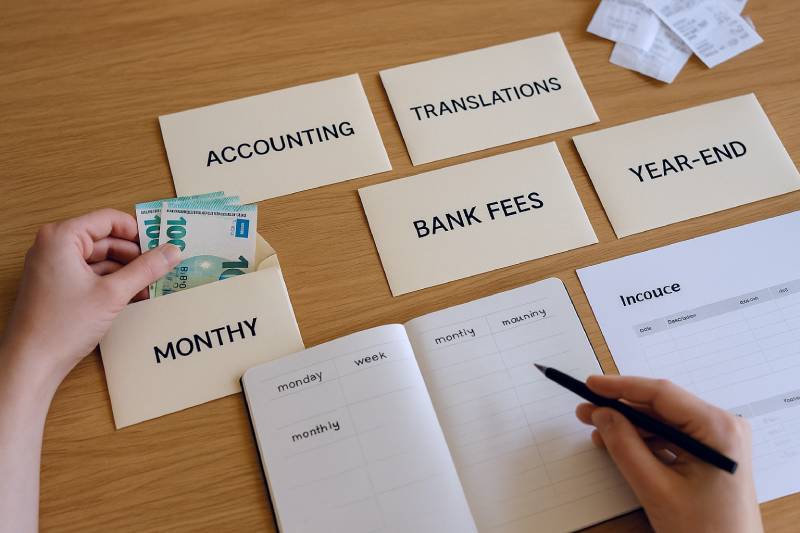
Think about tax and admin together. Below are typical ranges for a clean setup with monthly routines. For a deeper breakdown of corporate setup fees if you later switch, review how much it costs to set up a company in Bulgaria.
| Item | Self-Employed | Company (EOOD/OOD) | Notes |
|---|---|---|---|
| Setup (one-off) | 0–200 | 600–1,200 | Company has registry and legal costs |
| Accounting (monthly) | 80–150 | 120–300 | Volume, VAT, payroll affect price |
| Payroll service (per employee) | — | 30–80 + contributions | If you hire or pay the director |
| Annual accounts/publication | 120–250 | 200–500 | Publish on time to avoid penalties |
Common pitfalls (and how to avoid them)
- English-only invoices: Use bilingual templates so your details match Bulgarian requirements and EU VAT logic.
- Late VAT decision: Decide before the first invoice; store customer-location proofs where needed.
- Unmonitored address: Appoint someone to check mail weekly; store scans in your records.
- Year-end catch-up: Send documents monthly (by the 5th) to keep filings smooth.
- Unlimited liability blind spot: As income and risk grow, evaluate switching to an EOOD.
Who we are and how we help
We help freelancers and new founders choose the right Bulgarian path, align VAT and invoicing with EU rules, and run clean, audit-ready books. If you outgrow self-employment, we prepare filings, bank KYC, and templates so you start issuing company invoices without delay. See how we deliver fast, secure and tax-optimized company registration in Bulgaria, and learn about our accounting services in Bulgaria for steady monthly support.
If you decide to incorporate later: the short route
When the math and risk point to a company, follow a simple roadmap. For the strategic backdrop, read the reasons why Bulgaria is the best choice for your company formation. When you’re ready to move, use this practical walkthrough of how to register your company in Bulgaria in 6 steps and keep every document in one folder.
| Step | What You Prepare | Where It’s Filed/Used | Outcome |
|---|---|---|---|
| 1. Choose form | EOOD or OOD; activity brief | Planning stage | Governance & VAT plan aligned |
| 2. Incorporation pack | IDs, address, PoA (if remote) | Registry submission | Company number issued |
| 3. Bank onboarding | KYC pack, UBO chart | Bank meeting | Corporate IBAN |
| 4. VAT decision | Markets, OSS/IOSS where relevant | Tax registration | Correct VAT from day one |
| 5. Go-live | Bilingual invoice templates | Operations | First compliant invoices |
Book your free 30-minute consultation and get a tailored tax and compliance plan for your freelance activity in 2026—including when to switch to a company if that improves your net after tax.
Frequently Asked Questions
Do I need to register for VAT as a self-employed person in Bulgaria?
No, you do not always need to register for VAT as a self-employed person in Bulgaria, and to decide correctly you must assess turnover and the type and location of your clients before issuing invoices.
Can I switch from self-employed to an EOOD later without major disruption?
Yes, you can switch from self-employed to an EOOD later without major disruption, and to make it smooth you should plan bank onboarding, VAT, and invoice templates in advance.
Will a company always save me more tax than staying self-employed?
No, a company will not always save you more tax than staying self-employed, because at lower profits the higher admin costs can outweigh benefits, so you should compare your own numbers in euros for 2026.
Do I get residency in Bulgaria by being self-employed?
No, you do not automatically get residency in Bulgaria by being self-employed, and to manage visas or permits you need a separate application independent of tax status.
Can I run everything remotely while I live abroad?
Yes, you can run everything remotely while you live abroad, and to keep it efficient you should use a power of attorney, bilingual templates, and a monthly routine for sending documents on time.