

To manage remote bookkeeping for a Bulgarian company in 2026, you set up a cloud accounting stack, connect your Bulgarian bank feeds, agree simple monthly workflows with a licensed accountant, and meet Bulgaria’s VAT, payroll, and corporate-tax deadlines entirely online.
Key Takeaways
Remote Bookkeeping in Bulgaria: how it works in 2026
“Remote bookkeeping Bulgaria” means your company is registered in Bulgaria, yet everything runs online. Your accountant and you share a secure workspace to post entries, reconcile bank statements, issue e-invoices, process payroll, and send filings without in-person visits. If you are comparing jurisdictions first, see the strategic reasons Bulgaria is a strong base for company formation and make sure those benefits match your business model.
Company types, ownership, and what they mean for your books
Foreigners can own 100% of a Bulgarian company. Minimum share capital is symbolic, and you can transform the structure later as you grow. Here is a side-by-side view so you can pick fast and plan your bookkeeping accordingly.
| Form | Best for | Liability | Trading allowed | Bookkeeping complexity | Transformation options |
|---|---|---|---|---|---|
| EOOD (single-owner LTD) | Solo founders, consultants, SaaS | Limited to capital | Yes | Low: simple payroll + dividends | → OOD/AD if partners/investors join |
| OOD (multi-owner LTD) | Two or more co-founders | Limited to capital | Yes | Moderate: shareholders’ agreements drive payouts | → AD for larger governance |
| AD / EAD (joint-stock) | Scale-ups, regulated sectors, fundraising | Limited to capital | Yes | Higher: boards, audits more likely | Top tier—rarely needs change |
| Branch (of foreign company) | Testing the market while keeping HQ | Parent liable | Yes | Separate local ledgers and filings | Can reorganize into LTD |
| Representative office | Market research, liaison | Parent liable | No | Admin records, no revenue recognition | Form a new LTD to start trading |
Registered address and virtual office options
Every company needs a registered seat in Bulgaria for the Commercial Register. Remote founders usually choose a virtual office with mail scanning so bank cards, tax letters, and official notices are captured and archived.
| Option | Includes | Typical yearly cost (EUR) | Who chooses it | Notes |
|---|---|---|---|---|
| Registered seat only | Legal address for filings | 150–250 | Micro businesses | Collect mail or add scanning later |
| Virtual office + scanning | Seat, mail scan, call handling | 250–450 | Nomads and remote teams | Best if you never visit Bulgaria |
| Co-working address | Desk membership, meeting rooms | 600–1,200 | Client-facing EU traders | Extra “substance” for partners/banks |
To verify company details or recent changes, use the official Commercial Register (Registry Agency). Many procedures are available through the state e-portal at psc.egov.bg.
Banking for remote bookkeeping
You need a Bulgarian IBAN. Most banks now offer robust online banking; some support video KYC. Many founders combine a Bulgarian bank for payroll and local payments with an EU fintech for multi-currency collections. Keep business and personal spending strictly separate, and give your accountant read-only access for reconciliations.
| Provider | Onboarding | What you get | Monthly cost (EUR) | Good for |
|---|---|---|---|---|
| Traditional Bulgarian bank | In-branch or video KYC | BG IBAN, cards, SEPA, strong e-banking | 5–15 | Local payroll and suppliers |
| EU fintech (as a complement) | Online | Multi-currency IBANs, fast payouts, API | 0–20 | Cross-border SaaS/e-commerce |
For the regulatory backdrop and payments infrastructure, check the Bulgarian National Bank.
Taxes and VAT: simple workflows keep you compliant
Bulgaria’s tax rules are predictable if you maintain order. Your monthly loop is: issue/sync invoices, capture receipts with OCR, reconcile the bank, run payroll, review VAT, file on time, and archive documents. If you want to estimate profit and tax before you start, use this guide to calculate corporate tax in Bulgaria and then set your salary-dividend mix with your accountant.
Electronic filing, VAT registrations, and payroll declarations are handled via the tax authority’s systems—see the National Revenue Agency (NRA) for official e-services. Selling to EU consumers? Consider OSS/IOSS and the place-of-supply rules; the European Commission pages outline the frameworks and thresholds.
Self-employed vs LTD for remote founders
Sole traders are quick to start but put liability on you and can become tax-inefficient as profits grow. An EOOD (single-member LTD) protects you, scales better for hiring, and gives you cleaner options for salary/dividends. For a deeper comparison tailored to expats, read self-employed vs LTD in Bulgaria and weigh the admin against your growth plans.
Remote setup: from zero to “books are live”
| Step | What happens | Your task | Typical time |
|---|---|---|---|
| 1. Choose structure | EOOD/OOD, capital, director | Provide passport/KYC, sign drafts | 1–2 days |
| 2. Secure registered seat | Virtual office or co-working contract | Approve address service | 1 day |
| 3. File incorporation | Documents notarized if needed; filed online | e-Sign or courier originals | 3–7 days |
| 4. Open bank account | BG IBAN issued, cards ordered | Complete KYC; choose e-banking | 3–10 days |
| 5. Connect accounting stack | Chart of accounts; bank feeds; OCR app | Upload first month’s docs | 1–3 days |
| 6. Register VAT/payroll (if needed) | VAT number; social security registrations | Confirm dates, roles, and pay | 3–7 days |
If you prefer a guided path, here is how to register your company in Bulgaria in six steps—a quick overview you can follow before we plug your stack into a monthly routine.
Your 2026 remote-bookkeeping tech stack (lean and proven)
Choose tools that your accountant already supports. That cuts training, prevents errors, and keeps the close calendar tight.
| Layer | Purpose | What to look for | Why it matters remotely |
|---|---|---|---|
| Core accounting (GL) | Ledgers, journals, reports | Bulgarian chart, e-invoicing, CSV import | Entries posted without waiting on you |
| Invoicing / e-invoices | Sales invoices, audit trail | EU formats, recurring, meta fields | Clean VAT records and faster cash-collection |
| Bank feeds | Auto statement import | Direct connections, rules, matching | Removes manual errors and delays |
| OCR/Receipt capture | Digitize bills/receipts | Multi-language OCR, supplier rules | Real-time cost tracking |
| Payroll | Salaries and declarations | Bulgarian social codes, NRA e-filing | Tidy compliance and on-time payments |
| Document vault | Contracts, minutes, filings | Role-based access, retention | Auditors verify everything online |
Monthly workflows that prevent penalties
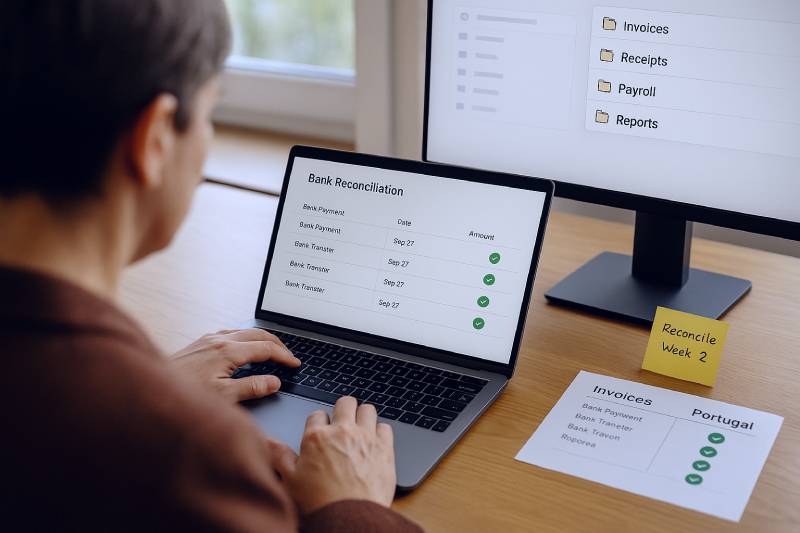
| Week | Tasks | Your role | Accountant’s role |
|---|---|---|---|
| Week 1 | Issue invoices; upload receipts; approve payroll | Upload docs; authorize payments | Post entries; calculate payslips; prep VAT |
| Week 2 | Reconcile bank; review late payers | Chase overdue invoices | Finalize reconciliation; draft VAT return |
| Week 3 | Approve VAT and social contributions | Fund payments | File through NRA e-services |
| Week 4 | Management report & forecast | Decide on expenses/dividends | Send P&L, cash-flow, tax estimate |
Realistic costs and timelines for remote bookkeeping
| Service | What’s included | Monthly (EUR) | Annual (EUR) |
|---|---|---|---|
| Bookkeeping package | Bank reconciliation, postings, reports | 150–350 | — |
| VAT compliance | Monthly/quarterly returns | <50–120 | — |
| Payroll (per employee) | Payslip, declarations, social security | 30–60 | — |
| Virtual office | Registered seat, mail scanning | — | 250–450 |
| Year-end accounts & corporate return | Financial statements and filing | — | 400–900 |
| Accounting software & apps | Core GL, OCR, payroll module | 20–60 | — |
| Milestone | Target timing | Dependencies |
|---|---|---|
| Company registered | 1–2 weeks | Signed docs, registered seat |
| Bank account live | 1–2 weeks | KYC completed, cards issued |
| Accounting stack connected | 2–3 days | Bank feeds, GL ready |
| First VAT return (if applicable) | End of first full period | Complete sales/purchase data |
Plan for setup fees too (incorporation, notary, translations, state fees). For a transparent breakdown, see how much it costs to set up a Bulgarian company. When you are ready to move from plan to action, we provide fast, secure, tax-optimized company registration in Bulgaria and then keep your numbers clean month after month.
Practical scenarios (picture your month)
Solo SaaS founder on an EOOD
You issue 10–20 invoices monthly to EU clients. The bank feed imports daily. On the 5th, you approve your director salary. On the 10th, you review VAT and fund the payment. On the 20th, you receive a one-page P&L with a cash-flow forecast. Your weekly time in the system is under an hour.
E-commerce brand with two employees
You sell across the EU and use OSS. Your accountant maps marketplace payouts, posts processor fees by rule, runs two payslips, files VAT monthly, and sends a margin analysis so you can adjust pricing. Stock and ads hold your attention—not bookkeeping.
Non-EU owner building toward residency
You incorporate an EOOD, open a Bulgarian bank account, and appoint yourself as manager. You run the company online while your immigration lawyer prepares your permit. When your residence card arrives, the payroll profile switches to domestic social security.
Controls auditors love (and that save founders time)
- Digital signatures: sign board minutes, management contracts, and accountant engagements remotely.
- Immutable archives: lock closed periods and follow retention rules so everything is retrievable.
- Access control: grant read-only bank access and use role-based folders for sensitive files.
- Payment approvals: two-step approvals for salaries, VAT, and larger supplier payments.
- Close calendar: fixed dates each month for reconciliation, filings, and management reporting.
When to hire an accountant (and what we handle)
You can issue invoices yourself, but a Bulgarian accountant protects you from penalties and keeps your cash-flow predictable. Expect postings, VAT, payroll, tax planning, and year-end financials. If you want a partner who embraces remote workflows, meet the team behind our accounting services in Bulgaria.
Ready to move?
Let’s set up your remote stack and keep your books clean from day one. Book a free 30-minute consultation and get a custom checklist for your business in 2026.
Official resources (bookmark)
- Company filings and lookups: Commercial Register (Registry Agency)
- Electronic services and e-procedures: Bulgarian e-Government portal
- Taxes and e-filing: National Revenue Agency
- Banking and payments system: Bulgarian National Bank
- EU VAT frameworks (OSS/IOSS): European Commission
Frequently Asked Questions
Can I manage Bulgarian bookkeeping 100% remotely?
Yes, managing Bulgarian bookkeeping 100% remotely is practical when you connect bank feeds, use cloud accounting, and authorize your accountant to file VAT, payroll, and corporate tax on time.
Do I have to be in Bulgaria to open a company bank account?
No, to open a company bank account you can often complete video KYC, although some banks still ask for a brief in-person visit.
Is an EOOD usually better than being self-employed for nomads?
Yes, for many nomads an EOOD is better than being self-employed because liability is limited and the salary-dividend mix is easier to optimize.
Can a representative office make sales in Bulgaria?
No, a representative office cannot make sales in Bulgaria because it is limited to marketing and research activities.
Can I switch from an EOOD to an OOD later if a partner joins?
Yes, you can switch from an EOOD to an OOD later by adopting shareholder resolutions and filing the change in the Commercial Register.