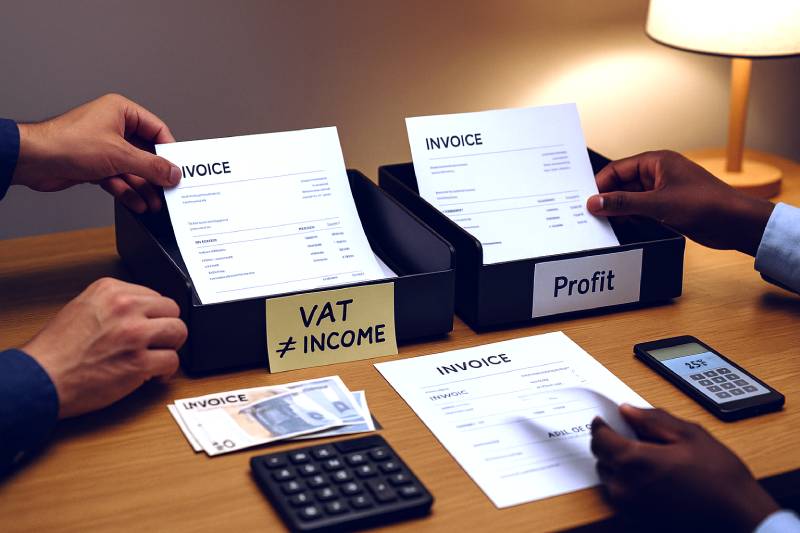

To calculate Bulgarian corporate tax in 2026, you determine taxable profit (revenue minus allowable expenses and adjustments), apply the flat corporate income tax to that profit, then plan distributions (salary or dividends) and VAT effects before filing and paying on the national schedule.
Corporate Tax Basics in Bulgaria for Foreign Founders
Whether you run an EOOD, OOD, EAD or AD, corporate income tax is calculated on your company’s taxable profit. That is your accounting profit adjusted by Bulgaria’s tax rules—especially around deductibility, depreciation, thin capitalization, and timing. For the official rate context and policy updates, see the Ministry of Finance at minfin.bg.
If you are new to the system, first get clear on the headline number. For a deeper explanation of the rate and how it’s applied across business forms, read our primer on the flat corporate tax rate in Bulgaria.
| Step | What You Do | Example (EUR) | Notes |
|---|---|---|---|
| 1) Revenue | Total invoiced sales | 200,000 | Exclude VAT you collect for the state |
| 2) Deductible expenses | Costs allowed by tax law | 120,000 | See deductible rules below |
| 3) Tax adjustments | Add backs / extra deductions | +5,000 | e.g., non-deductibles added back |
| 4) Taxable profit | Revenue − expenses ± adjustments | 85,000 | Basis for corporate tax |
| 5) Corporate tax | Apply the flat rate | 8,500 | Pay and file on time |
Step-by-Step: How to Calculate Your Company Profit Tax
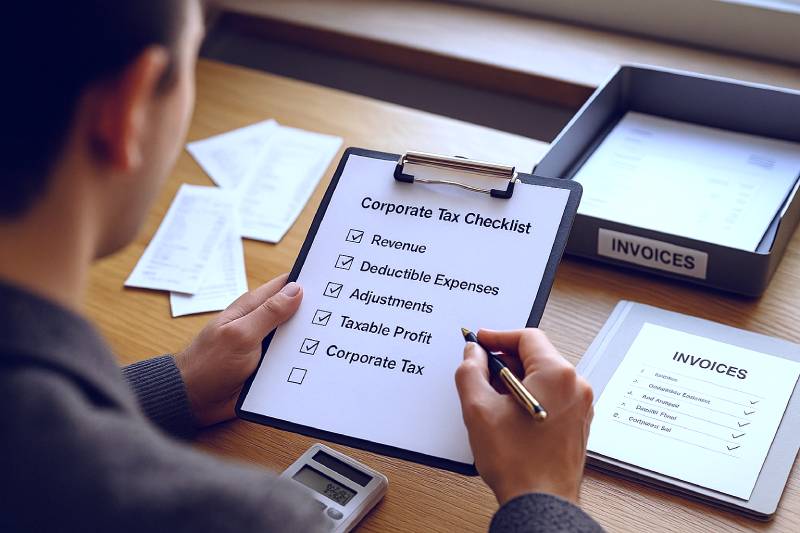
Follow this practical sequence and you will rarely go wrong.
1) Confirm your legal form and capital
Most foreign founders start with EOOD/OOD for simplicity and low capital. JSC forms (EAD/AD) suit investor-ready projects. These choices do not change the headline tax rate, but they affect governance, equity rounds, and audits.
2) Separate VAT from revenue
VAT collected is not income; it’s owed to the tax authority. Handle VAT correctly and your profit calculation stays clean. If you’re unsure about the VAT angle, bookmark our Bulgarian VAT guide for founders. For EU cross-border frameworks, the European Commission centralises official guidance at ec.europa.eu.
3) Classify and evidence deductible expenses
Bulgarian law allows normal, necessary, and business-related expenses. You need invoices, contracts, bank proof, and—where applicable—travel orders or timesheets. For a deep dive on what you may subtract, visit our guide to deductible expenses in Bulgaria.
| Category | Typically Deductible? | Evidence You Keep | Founder Tip |
|---|---|---|---|
| Staff & contractor costs | Yes | Contracts, payroll, invoices | Use proper agreements |
| Office & software | Yes | Invoices, licenses | Separate personal use |
| Travel & client meetings | Yes | Tickets, hotel invoices, agenda | Document business purpose |
| Fines & penalties | No | — | Don’t net against income |
| Luxury or personal spending | No | — | Keep it off the company |
4) Make tax adjustments
Typical adjustments include adding back non-deductibles, applying depreciation, interest limits, and transfer pricing where relevant. The National Revenue Agency publishes rules, forms, and deadlines for returns.
5) Apply the corporate rate and plan distributions
Once you have taxable profit, apply the flat rate to get your corporate tax. After that, decide how you pay yourself: salary, dividends, or a mix. To navigate this choice, see our practical comparison of dividends vs salary in Bulgaria.
Entity Choice and Tax: EOOD, OOD, EAD, AD
The structure you choose affects capital, governance, and investor perception. The core calculation stays the same, but audits or board approvals may add internal steps before filing.
| Form | Owners | Capital (EUR) | Governance | Operational Impact |
|---|---|---|---|---|
| EOOD | 1 | ~1 | Director-managed | Fast decisions, lean compliance |
| OOD | 2+ | ~1 (total) | Members + director | Shareholder approvals for key steps |
| EAD | 1 | 25,000 | Board or sole director | Audit more likely as you scale |
| AD | 2+ | 25,000 | One- or two-tier board | Investor-friendly governance |
VAT, Invoicing, and Their Effect on Corporate Tax
VAT does not change the corporate rate, but it changes cash flow and paperwork. In some cases you charge VAT; in others, you reverse charge or fall under special regimes. These choices impact margins, not the formula for profit tax.
| Scenario | VAT Treatment | Effect on Profit | What to Watch |
|---|---|---|---|
| Domestic B2B services | Charge VAT if registered | VAT is not income | Track input VAT on costs |
| EU B2B services | Often reverse charge | Net sales unaffected by VAT | Correct place-of-supply |
| EU B2C digital | VAT rules by customer location | Margins vary by rate | Register under the right scheme |
| Exports outside EU | Usually zero-rated | VAT cash flow improves | Keep customs proofs |
Address, Bank Account, and Remote Setup—Compliance Foundations
You need a reliable registered address for the tax office and banks to reach you. A Bulgarian bank account simplifies paying taxes and receiving refunds. Many founders incorporate remotely via PoA, then let their accountant manage monthly filings. If you prefer a done-for-you route, we provide fast, secure and tax-optimized company registration in Bulgaria.
Tax Calendar and Deadlines in 2026
Your company must file and pay on time. While dates can vary by case, this founder-friendly calendar covers the typical rhythm most SMEs face.
| When | What | Why It Matters | Founder Tip |
|---|---|---|---|
| Monthly | VAT returns (if registered) | Avoid penalties and interest | Close books monthly |
| Quarterly | Advance tax, if applicable | Spreads your cash flow | Forecast profits early |
| Year-end | Annual financial statements | Foundation for your tax return | Schedule audit if required |
| After year-end | Corporate tax return and payment | Final settlement | Book a filing week with your CPA |
For current forms and e-services, the National Revenue Agency keeps the official portal at nra.bg (already used once above).
Worked Examples: From Revenue to Tax
Let’s translate the framework into simple scenarios with clean numbers.
| Scenario | Revenue | Deductible Costs | Adjustments | Taxable Profit | Corporate Tax | Notes |
|---|---|---|---|---|---|---|
| Remote consulting EOOD | 120,000 | 60,000 | +2,000 (add-backs) | 62,000 | 6,200 | Light assets, focus on service costs |
| Agency OOD with small team | 300,000 | 210,000 | +5,000 | 85,000 | 8,500 | Payroll and software dominate |
| Product startup (EAD) | 600,000 | 430,000 | +10,000 | 160,000 | 16,000 | Capex and depreciation matter |
Salary or Dividends After Tax?
Once you know your profit and corporate tax, decide how you’ll get paid. Salaries are deductible for the company but taxed as personal income and subject to social contributions. Dividends are paid from after-tax profit and have their own withholding rules. For a founder-friendly comparison with numbers and trade-offs, read dividends vs salary in Bulgaria.
Branches, Representative Offices, and Cross-Border Setups
If you already have a foreign parent, you can open a Bulgarian Branch that trades locally, or a Trade Representative Office that does not trade. Tax outcomes differ because a branch is part of the foreign company for profit attribution, while a representative office cannot issue invoices. If you are still choosing the best base, here are reasons why Bulgaria is an attractive company formation location, and here is how to register your company in six steps.
Realistic Annual Costs and What to Budget
Even with lean operations, build a small compliance budget into your plan. It pays for itself in peace of mind and penalty avoidance. For a broader setup estimate beyond taxes, review how much it costs to set up your company in Bulgaria.
| Line Item | Typical Amount | Why It Matters | How to Keep It Lean |
|---|---|---|---|
| Monthly accounting | from 120 | Books, VAT, returns | Automate bank feeds |
| Annual financial statements | 300–600 | Statutory compliance | Close monthly to save time |
| Corporate tax return | 150–300 | Final settlement | Keep a clean evidence pack |
| Payroll administration (per employee) | 20–40 | Contracts and social security | Standardize contracts |
If you’d like a single team to handle ledgers, VAT, payroll, and filings, our specialists can take it off your plate—learn more about accounting services in Bulgaria.
Common Pitfalls That Skew Your Tax Bill
Most surprises come from the same few mistakes. Here’s how to dodge them.
| Pitfall | Why It Hurts | Fix |
|---|---|---|
| Treating VAT as revenue | Inflates profit and tax | Separate VAT in your books |
| Weak expense evidence | Disallowed deductions | Collect proper invoices and contracts |
| Non-deductible items netted in costs | Add-backs increase profit | Classify and disclose correctly |
| Missed deadlines | Penalties and interest | Calendar monthly closes and returns |
| No plan for distributions | Sub-optimal founder take-home | Model salary vs dividends |
Your Next Step—Talk to a Specialist
Tell us your revenue model, client geography, and hiring plans. We’ll map a clean route from invoicing to year-end with the right VAT setup and founder pay mix for 2026. Book a free 30-minute consultation and start with a tax-clean company from day one.
Frequently Asked Questions
Is corporate tax in Bulgaria calculated on revenue or profit?
Yes, corporate tax in Bulgaria is calculated on profit, because the tax base is your taxable profit after deducting allowable expenses and applying tax adjustments, not your turnover.
Do I include VAT collected in my corporate tax calculation?
No, you do not include VAT collected in your corporate tax calculation, because VAT you charge customers is not company income and must be separated from revenue.
Can I reduce Bulgarian corporate tax by paying myself a salary?
Yes, you can reduce Bulgarian corporate tax by paying yourself a salary, because salaries are deductible business expenses for the company, although they are taxable to you personally.
Do I need to change my entity form to optimise corporate tax?
No, you do not need to change your entity form to optimise corporate tax, because the headline corporate rate is flat across forms, though governance and audit requirements differ.
Should I register for VAT to lower my corporate tax bill?
No, you should not register for VAT just to lower your corporate tax bill, because VAT is a separate system focused on consumption taxes, not on reducing your company’s profit tax.