
To know when you need VAT registration in Bulgaria, you check whether your activity hits a mandatory trigger—like crossing the domestic turnover threshold, making certain cross-border supplies, importing low-value goods, or opting in voluntarily—then you register for the right scheme (domestic VAT, OSS, or IOSS) and start filing returns in 2026.
Bulgarian VAT Registration Explained for Foreign Founders
VAT in Bulgaria follows EU rules, with local administration by the National Revenue Agency. If you operate a Bulgarian company—or a foreign company trading in Bulgaria—you must register when a legal trigger applies. Common triggers are crossing the local turnover threshold, supplying digital services to EU consumers, distance selling goods into other EU countries, or importing low-value parcels.
If you’re just estimating your overall tax picture, you may also want the step-by-step method to calculate corporate tax and a refresher on Bulgaria’s corporate tax rate. VAT sits alongside these—not instead of them.
| Trigger | Typical Use Case | Registration Outcome | Evidence You Need | What to Watch |
|---|---|---|---|---|
| Domestic turnover threshold | Bulgarian EOOD selling services to local customers | Mandatory domestic VAT | Invoices, ledgers proving turnover | Track rolling 12-month periods |
| EU B2C digital services | Apps, SaaS, streaming to EU consumers | Union OSS registration | Customer location evidence (two non-conflicting proofs) | Charge the customer’s country VAT rate |
| EU distance sales of goods | E-commerce shipping from BG to EU consumers | Union OSS (for multiple countries) | Shipping docs, order logs | Local rates across EU destinations |
| Imports ≤ 150 EUR parcel value | Direct-to-consumer micro-imports | IOSS (optional but simpler) | Customs data, IOSS number usage | One-stop monthly return on imports |
| Voluntary registration | Agency with input VAT on costs | Domestic VAT by choice | Supplier invoices, contracts | Cash-flow impact vs input VAT recovery |
The EU Rules Behind Bulgarian VAT
Bulgaria’s VAT rules align with EU law and the EU VAT Directive, which defines the overall framework of place-of-supply, rates, and special schemes. For official EU-level guidance and cross-border examples, see the European Commission’s VAT guidance and the legal base in the EU VAT Directive.
Which VAT Scheme Do You Need? (Domestic, Union OSS, IOSS)
Choose the scheme that matches your customers and your logistics. Getting this right prevents double registrations and mismatched rates.
| Scheme | When It Applies | How You Charge VAT | Returns & Where Filed | Ideal For |
|---|---|---|---|---|
| Domestic VAT (Bulgaria) | Local activity or threshold hit | Bulgarian VAT rate | Monthly/quarterly in Bulgaria | Local services, domestic sales |
| Union OSS | EU B2C services & distance sales | Customer’s country VAT rate | Quarterly OSS return via Bulgaria | Cross-border e-commerce, SaaS |
| IOSS | Imports ≤ 150 EUR to EU consumers | VAT collected at checkout | Monthly IOSS return via Bulgaria | Micro-imports D2C brands |
How to Decide—Practical Scenarios
Use these simple patterns to map your path quickly.
| Your Model | Customers | Goods/Services | Likely Registration | Notes |
|---|---|---|---|---|
| Solo consultant (EOOD) | Bulgarian companies | Services | Domestic VAT when threshold is exceeded (or voluntary) | Keep eye on rolling turnover |
| Micro-SaaS | EU consumers | Digital services | Union OSS | Apply destination VAT rates |
| Shopify store in Sofia | EU consumers | Physical goods | Union OSS (for distance sales) | Mind returns and rate tables |
| Dropship imports | EU consumers | Low-value goods | IOSS | Collect VAT at checkout |
| Agency with EU B2B clients | EU companies (VAT-registered) | Services | Reverse charge (no VAT on invoice) | Collect valid VAT IDs |
How VAT Interacts with Corporate Tax and Founder Pay
VAT never reduces your corporate tax directly. It changes cash flow, not the profit formula. For the profit calculation and what you pay the state as a company, see how to calculate corporate tax. For a refresher on the flat rate itself, revisit Bulgaria’s corporate tax rate explained. If you’re designing a borderless solo setup, check a digital-nomad-friendly tax strategy that actually matches your client geography.
Invoicing, Evidence, and Refunds—What Auditors Expect
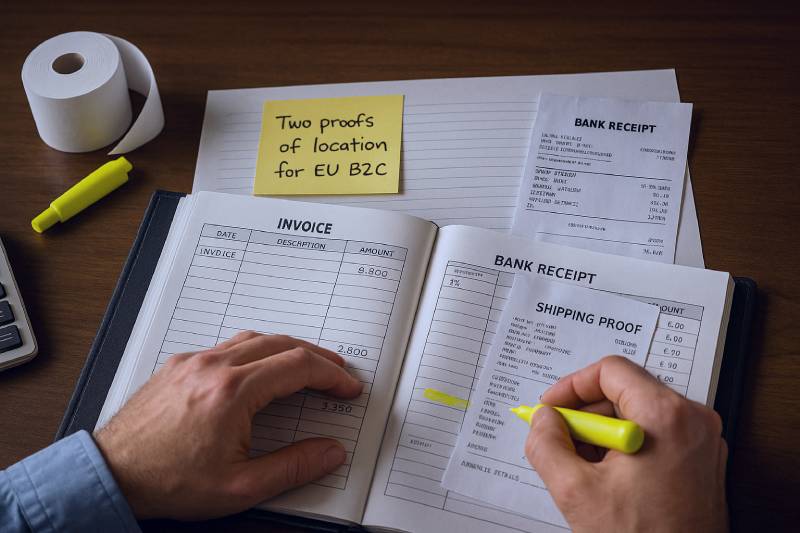
The golden rule: collect two consistent proofs of customer location for EU B2C digital services (e.g., billing country and IP), preserve shipping proof for goods, and reconcile bank receipts to invoices. That’s how you survive audits and qualify for VAT refunds on time.
| Supply Type | Key Evidence | Why It Matters | Founder Tip |
|---|---|---|---|
| B2C digital services (EU) | Two location proofs, invoice logs | Correct destination VAT rate | Automate country-rate mapping |
| Distance sales of goods | Shipping & delivery proof | Treatment & refunds | Pair orders with courier IDs |
| Domestic services | Invoices, contracts | Input VAT deduction | Match payments monthly |
| Reverse-charge B2B | Customer VAT ID validation | Zero-rating on invoice | Store VIES screenshots |
Registration Steps, Timelines, and Documents
Most registrations run smoothly if your books already reflect real activity (invoices, contracts, bank statements). Your accountant can file online on your behalf.
| Step | You Provide | We File | Typical Time | Common Pitfall |
|---|---|---|---|---|
| 1) Pre-check | Business model & client map | Scheme selection (Domestic/OSS/IOSS) | Same day | Wrong scheme for sales mix |
| 2) Evidence pack | Contracts, invoices, bank proof | Online application | 1–3 days | Thin evidence slows approval |
| 3) VAT number issued | — | Confirmation & activation | Same day to a few days | Delays if data mismatches |
| 4) First return | Sales & input VAT ledgers | Return submission | Monthly/quarterly | Late filings risk penalties |
Address, Bank Account, Remote Setup—What VAT Filers Need
You need a reachable registered address for notices and a bank account that integrates well with your bookkeeping. Many founders do everything remotely with a Power of Attorney and then keep monthly filings on autopilot. If you prefer a one-partner approach from incorporation to VAT, we provide fast, secure and tax-optimized company registration in Bulgaria.
| Item | Why VAT Cares | What Good Looks Like | Founder Tip |
|---|---|---|---|
| Registered address | Official contact & audits | Active mail handling | Use a provider, not a friend’s flat |
| Bank account | Receipts & refund flows | EUR account with feeds | Automate bank reconciliation |
| Accounting | Accurate returns & refunds | Monthly closed books | Delegate to a VAT-savvy team |
How to Charge and Record VAT—Simple Numbers
Here’s a clean example showing the mechanics for a domestic sale and an EU B2C OSS sale.
| Scenario | Net Price | VAT Rate | VAT Charged | Gross Collected | Where You Report |
|---|---|---|---|---|---|
| Domestic service (BG customer) | 1,000 | Local BG rate | e.g., 200 | 1,200 | Domestic VAT return |
| EU B2C digital (OSS) | 1,000 | Customer country rate | e.g., 230 | 1,230 | Union OSS return |
Compliance Calendar in 2026—Rhythm That Works
Consistency beats heroics. Close your books monthly, validate VAT IDs for B2B, and keep separate ledgers for domestic, EU OSS, and IOSS if you use more than one scheme.
| Cadence | Task | Why | How to Stay On Track |
|---|---|---|---|
| Monthly | Domestic VAT returns & ledgers | Avoid penalties, smooth cash flow | Automate bank/imports, reconcile |
| Quarterly | Union OSS return (if applicable) | Single filing for multiple EU states | Tag sales by customer country |
| Monthly | IOSS return (if applicable) | Fast customs clearance & VAT pass-through | Capture IOSS number in orders |
| Year-end | Financials & corporate tax | Profit tax is separate from VAT | Coordinate with your accountant |
Costs and Return on Effort
Registration and ongoing filings are cost-effective for most founders—especially when input VAT on software, advertising, and logistics is significant. For broader budgeting beyond VAT, see the cost to set up a company in Bulgaria, review reasons Bulgaria is a strong company formation base, and follow the six-step company registration path. If you want a done-for-you monthly service, our accounting services in Bulgaria keep you compliant while you focus on sales.
| Line Item | Typical Cost | What You Get | Founder Tip |
|---|---|---|---|
| VAT registration (domestic/OSS/IOSS) | ~250–450 | Application, evidence, activation | Prepare contracts & model summary |
| Monthly domestic VAT return | ~60–120 | Books, return, submission | Close books monthly |
| Quarterly Union OSS return | ~80–150 | Consolidated EU filing | Map rates by country |
| Monthly IOSS return | ~80–150 | Import VAT one-stop filing | Capture IOSS at checkout |
Common VAT Mistakes—and How to Avoid Them
Most VAT issues trace back to two things: not knowing where your customer is for VAT purposes, and mixing VAT with revenue. Fix both and most of the pain disappears.
| Mistake | Why It’s Costly | Prevention |
|---|---|---|
| Treating VAT as income | Inflates turnover and profit | Separate VAT in books & reports |
| Wrong scheme choice | Double registration & fines | Map model → scheme before filing |
| No location evidence (B2C) | Wrong VAT rate applied | Collect two non-conflicting proofs |
| Late filings | Penalties & blocked refunds | Calendar monthly closes |
| Ignoring imports workflow | Delays at customs | Use IOSS for low-value parcels |
Talk to a VAT-Savvy Team—Free 30-Minute Call
Tell us your product, customer map, and sales channels. We’ll set up the right scheme (Domestic/OSS/IOSS), automate evidence collection, and keep filings clean in 2026. Book your free 30-minute consultation and ship with confidence.
Frequently Asked Questions
Do I need VAT registration if I only sell services inside Bulgaria?
Yes, you need VAT registration if you only sell services inside Bulgaria once your domestic taxable turnover crosses the legal threshold, because local rules make registration mandatory after that point.
Do EU B2C digital services require Bulgarian VAT registration?
Yes, EU B2C digital services require Bulgarian VAT registration under the Union OSS scheme, because you must charge the consumer’s country rate and declare it through a single OSS return.
Do distance sales of goods to EU consumers need OSS?
Yes, distance sales of goods to EU consumers need OSS when you sell cross-border, because the scheme lets you report multi-country VAT in one Bulgarian OSS return.
Can I recover input VAT on software, ads, and logistics?
Yes, you can recover input VAT on software, ads, and logistics, because these are typical business expenses linked to taxable activity when backed by valid invoices.
Should I register voluntarily for VAT before hitting the threshold?
Yes, you should register voluntarily for VAT before hitting the threshold if your input VAT is significant or your clients prefer VAT invoices, because early registration can improve cash flow and credibility.